1Password已将Codex集成到软件交付生命周期的各个环节,以缩短从规划到生产之间的时间,从而能够快速构建新功能。1Password团队将拉取请求的中位周期时间缩短了近11%,并为核心用户群提升了近21%的工程生产力。
基于工程部门的成果,1Password的领导团队正在将Codex的访问权限扩展到其他职能部门,使财务、市场等团队能够构建自己的工具和功能。在整个过程中,1Password始终坚持严格的安全标准,确保在提升速度与保护数据之间不存在取舍。
“对我们许多工程师来说,真正令人大开眼界的是缩短了从规划到在生产环境中看到功能之间的生命周期。”
——Nancy Wang,1Password首席技术官
使用Codex一次性完成新功能
1Password正在利用Codex将创意从规划阶段更快地推进到实施阶段,帮助工程师将定义明确的用户故事转化为可运行的功能。
“以前,你需要进入一个项目,思考如何将其分解为不同的冲刺,并将不同的冲刺分配给工程敏捷团队,”1Password首席技术官Nancy Wang解释道。“有了Codex,你实际上可以一次性完成,从创意到原型,再到在生产环境中完全可用的功能。”
“对于我们的工作流程,Codex通过提供用户故事以及我们希望用户体验到的说明,使得一次性完成功能变得更快、更容易,减少了工程审查前所需的迭代次数,”Wang表示。
这项工作已催生出众多新功能,既有内部工具,也有面向客户的产品。一个例子是Knox,这是一个完全智能化的前端设计系统,帮助1Password团队构建新界面。其他例子包括内部AI站点可靠性工程代理和AI支出管理工具。
1Password在明确定义的工程和安全边界内,给予Codex自主工作的空间。“Codex实际上会将所请求的功能分解为功能规格,并构建一个接近最终版本的原型,然后我们可以将其交给系统工程师构建到后端中,”Wang说。这种方法减少了交接时间,提高了工程生产力。工程师编写代码的速度更快,在规划、实施和审查之间的交接上花费的时间也更少。
Codex贯穿软件交付生命周期
Codex涉及从规划到生产的每一个步骤:
- 规划与技术设计:将请求转化为规格、依赖检查和工作项。
- 跨技术栈实施:通过CLI帮助工程师熟悉陌生的Rust和TypeScript代码;并行工作树可同时运行任务。
- 拉取请求审查:在人工审查之前检查变更,标记逻辑问题和缺失上下文。
- 测试与发布准备:与其他工作并行运行验收标准和自动化测试。
- 安全与访问:与1Password内部应用安全框架集成;密钥引用确保明文凭据不会进入模型上下文。
- 生产调查:从事件管理、遥测、源代码控制、分页和功能开关中收集证据。
成果概览
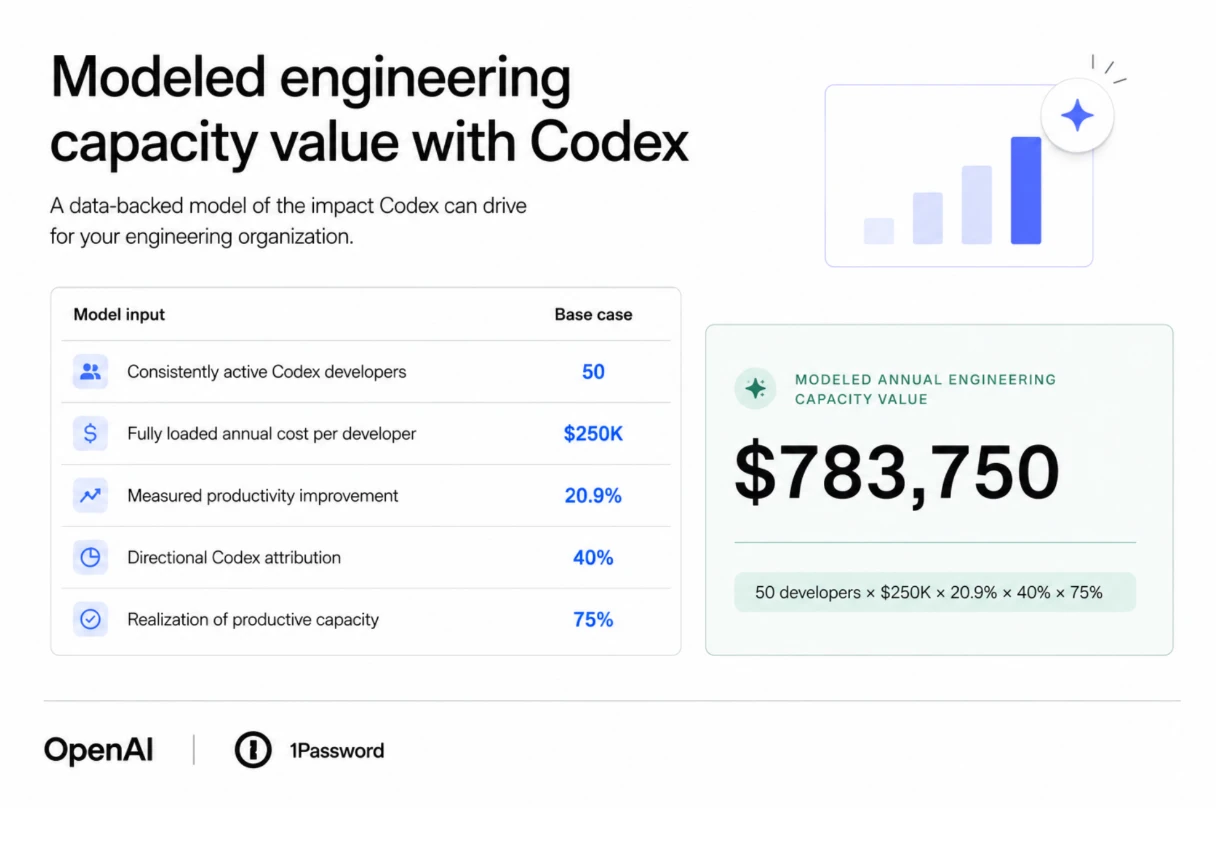
建模年度工程产能价值:783,750美元,基于50名持续活跃的Codex开发者、每名开发者25万美元的全额年成本、20.9%的实测生产力提升、40%的方向性Codex归因以及75%的产能实现率。
随着1Password将Codex集成到其软件开发生命周期中,工程团队记录到生产力提升了20.9%,拉取请求中位周期时间缩短了10.9%。一名在自身常规技术栈之外贡献的工程师将通常需要三天的合并缩短至一天;一个面临固定测试版发布日期的团队完成了四个发布关键工单,而他们通常预计只能完成约两个。
对于跨越10多个微服务的缺陷,调查时间从约两小时缩短至5至20分钟。对于50名Codex用户的建模队列,1Password估计每年约可增加784,000美元的工程产能,投资回报率为553%,这些产能被重新投入到产品开发和内部创新中。若持续使用用户达到100人,假设Codex在实测生产力提升中占更大份额,建模年度产能价值可能达到约310万美元。
“如果我们能够真正加快客户反馈与UI快速更改之间的反馈循环,那将为业务释放大量潜力。”
——Nancy Wang,1Password首席技术官
在开发速度提升的同时维护安全
1Password还正在向财务、市场及其他团队推广OpenAI工具,在这些团队中,聊天界面已成为日常操作的一部分。
对于1Password而言,其安全模型是采用的设计要求,而非使用扩展后再添加的控制措施。“我们在构建产品方面有着非常严格的安全姿态,”Wang说。例如,任何涉及凭据或密钥的产品都需要遵循零知识架构,该架构的设计确保只有客户才能解密和访问其敏感数据。
1Password通过在存储库中保留密钥引用而非凭据来实施这一原则。当Codex调用经批准的内部工具时,1Password会在操作点解析并注入凭据,因此明文值永远不会进入模型上下文。
为进一步加强安全,1Password工程师还将公司的安全策略“融入可复用的应用安全技能中”,使公司标准能够随开发工作流程一同流转,Wang解释道。“这改变了游戏规则。”
未来展望
Wang和1Password团队认为,在不久的将来,通过“民主化构建”,软件生产将变得更加普及:更多角色可以构建软件。如果说第一波浪潮是工程师成为AI辅助的构建者,Wang表示,“我们现在正处于第二波浪潮中。产品、设计、研发领域的每个人都在成为构建者。产品经理开始交付产品,设计师开始交付前端代码。”
Wang预测这一趋势将扩展到每个角色。“我认为最后一公里实际上是让公司中的每个人都能够构建,”她说。“这就是我们在未来12个月将看到的景象——那些传统上不编写代码或自认为不是构建者的人,将变得对AI工具如此熟悉,以至于他们能够自信地交付代码。”
1Password has integrated Codex across the software delivery lifecycle to compress the time between planning and production, allowing it to build new features at a rapid pace. The 1Password team has cut median pull request cycle time by nearly 11% and improved engineering productivity by almost 21% for its core user cohort.
Based on engineering's results, 1Password's leadership team is expanding access to Codex to other functions, enabling teams such as finance and marketing to build their own tools and features. Throughout, 1Password maintained its rigorous security standards, ensuring there's no tradeoff between increasing its speed and protecting its data.
“What’s been really eye-opening for a lot of our engineers is shortening the lifecycle between planning and being able to see a feature in production.”
—Nancy Wang, CTO, 1Password
One-shotting new features with Codex
1Password is using Codex to move ideas from planning to implementation faster, helping engineers turn well-defined user stories into working features.
“Previously, you would go into a project, think about how to break it down into different sprints, and assign different sprints to engineering scrum teams,” explains Nancy Wang, CTO at 1Password. “With Codex, you can actually one-shot, going from an idea to a prototype to a feature that works fully in production.”
“For our workflow, Codex made it faster and easier to one-shot features by giving it a user story and instructions about what we want the user to experience, reducing the iteration required before engineering review,” Wang says.
This work has resulted in numerous new features, both internal tools and customer-facing products. One example is Knox, a fully agentic frontend design system that helps teams at 1Password build new interfaces. Other examples include an internal AI site reliability engineering (SRE) agent and an AI spend management tool.
1Password gives Codex room to work autonomously inside clearly defined engineering and security boundaries. “Codex will actually break the requested feature down into functional specs and build a near-final prototype that then we can hand to our systems engineers to build into our backend,” Wang says. This approach reduced handoff time and improved engineering productivity. Engineers are writing code faster and spending less time on the handoffs between planning, implementation, and review.
Codex across the software delivery lifecycle
Codex touches every step from planning to production:
- Planning and technical design: Turns requests into specs, dependency checks, and work items.
- Implementation across stacks: Helps engineers navigate unfamiliar Rust and TypeScript code via CLI; parallel worktrees run tasks simultaneously.
- Pull request review: Reviews changes before a human, flags logic issues and missing context.
- Testing and release readiness: Runs acceptance criteria and automated tests in parallel with other work.
- Security and access: Ties into 1Password's internal AppSec harness; secret references keep plaintext credentials out of model context.
- Production investigation: Pulls evidence across incident management, telemetry, source control, paging, and feature flags.
Results at a glance
Modeled annual engineering capacity value: $783,750, based on 50 consistently active Codex developers, a $250,000 fully loaded annual cost per developer, 20.9% measured productivity improvement, 40% directional Codex attribution, and 75% realization of productive capacity.
As 1Password integrated Codex across its software development lifecycle, engineering teams recorded a 20.9% productivity improvement and a 10.9% reduction in median pull request cycle time. An engineer contributing outside their usual stack cut a typical three-day merge down to one day, and a team facing a fixed beta launch date completed four release-critical tickets instead of the roughly two they would normally expect.
For a defect spanning more than 10 microservices, investigation time fell from about two hours to 5–20 minutes. For a modeled cohort of 50 Codex users, 1Password estimates approximately $784,000 in annual engineering capacity and a 553% ROI, with capacity reinvested in product development and internal innovation. At 100 consistent users, the modeled annual capacity value could reach approximately $3.1 million, assuming Codex accounts for a larger share of the measured productivity improvement.
“If we can actually speed up that feedback loop between customer feedback and making quick changes in our UI, that’s going to really unlock a lot of things for the business.”
—Nancy Wang, CTO, 1Password
Maintaining security as the speed of development rises
1Password is also rolling out OpenAI tools to finance, marketing, and other teams, where the chat interface has become second nature.
For 1Password, its security model is a design requirement for adoption, not a control to add after usage expands. “We have a very stringent security posture in terms of how we build products,” Wang says. Any product that touches credentials or secrets, for example, needs to adhere to a zero-knowledge architecture designed so that only the customer can decrypt and access their sensitive data.
1Password implements that principle by keeping secret references, rather than credentials, in repositories. When Codex calls an approved internal tool, 1Password resolves and injects the credential at the point of action, so the plaintext value never enters the model context.
To further strengthen security, 1Password engineers have also taken the company's security policies and “baked that into reusable AppSec skills,” allowing the company's standards to travel with the development workflow, Wang explains. “That's been a game changer.”
What's next
Wang and the 1Password team see software production becoming more accessible in the near future through “democratized building”: more roles can build software. If the first wave was about engineers becoming AI-assisted builders, Wang says, “We're now squarely in the second wave. Everyone in product, design, research, and development is becoming builders. PMs are starting to ship products, and designers are starting to ship front-end code.”
Wang predicts this trend spreading across every role. “I think the last mile is actually getting everybody in a company to build,” she says. “That's what we're going to see over the next 12 months, folks who are traditionally not writing code or who don't think of themselves as builders becoming so comfortable with AI tools that they can ship code confidently.”
本文内容采集自官方网站,排版和翻译可能与原页面存在差异。
阅读官方全文