量子计算是一种新兴技术,利用量子力学的独特性质来处理信息。它未来或许能更好地模拟复杂材料和分子。与传统处理器不同,量子处理器由量子比特(qubit)构成。准备和运行量子比特实验可能需要数月时间,并需进行数百到数千次初步测量——而人工智能正有望在这方面提供帮助。
Beatriz Yankelevich是麻省理工学院工程量子系统小组(EQuS)的一名研究生,她使用搭载于Codex的GPT‑5.6 Sol来探索AI能否简化她的实验工作流程。该MIT小组研究超导量子比特,这些量子比特在称为稀释制冷机的专用设备中被冷却至接近绝对零度。这些量子比特运算速度快,可通过微波信号精确控制,并能利用成熟的制造技术制成并排列在芯片上。
一旦超导量子比特芯片完成制造、封装和冷却,研究人员便完全通过软件与其交互,这使得Yankelevich的实验成为AI代理的理想测试平台。将Codex连接到协调实验的实验室软件后,它能够运行测量、分析结果,并决定下一步尝试什么。Yankelevich发现,GPT‑5.6 Sol通常能自主完成常规测量工作流程,为她节省了大量时间,并使实验无需持续监督即可运行。这让她得以将更多时间用于分析结果、设计实验以及规划研究的后续步骤。
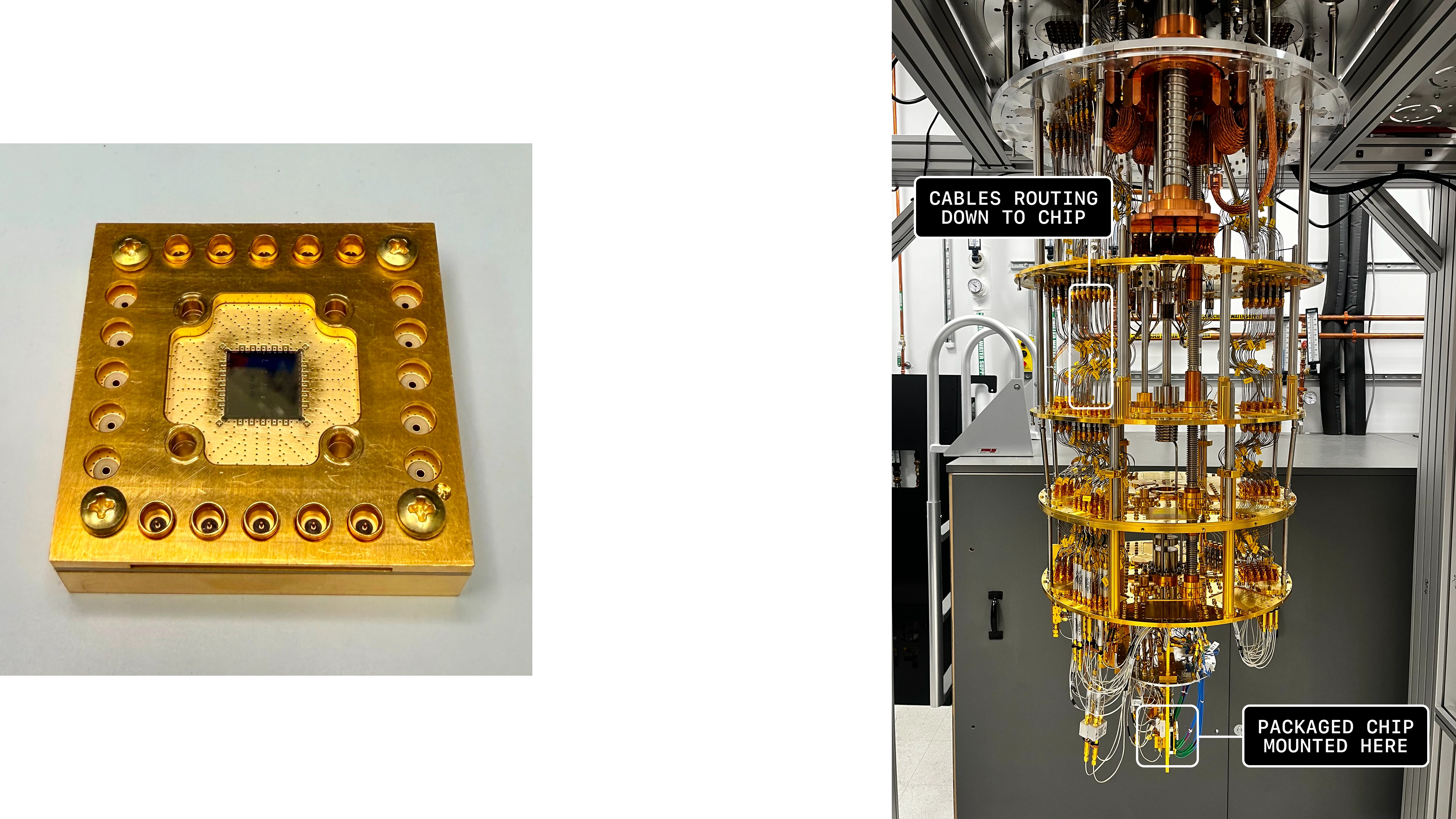
封装好的量子比特芯片(左)放置在打开的稀释制冷机(右)内。图片来源:EQuS小组
协调相互依赖的测量
超导量子比特常被称为人造原子,因为与原子一样,它们只能占据特定的能级。微波脉冲使量子比特在这些能级之间跃迁,并探测其量子态。研究人员设计并校准发送到芯片的脉冲序列,然后对返回信号进行数字化和分析。这些测量揭示了每个量子比特的共振频率,使研究人员能够精确控制量子比特;量子比特保留量子信息的时间;以及执行计算所需的设置。
校准量子比特需要一系列相互依赖的测量,每个结果都会影响后续步骤。量子比特的特性偶尔会发生漂移,意外的物理行为可能导致结果不一致。经验丰富的研究人员能够识别这些变化并在发生时进行调整。软件控制、重复测量和自适应决策的结合,也使量子比特校准成为AI代理的一个极具吸引力的应用场景。
Yankelevich测试了GPT‑5.6 Sol在一块未校准的六量子比特芯片上运行测量的能力,该芯片是EQuS用于基准测试其制造工艺的标准类型之一。她为Codex提供了特定于测量的技能,解释了如何运行和评估每项实验。利用这些技能和芯片的设计目标,GPT‑5.6 Sol选择了测量参数,操作硬件,分析所得数据,然后要么优化测量,要么保存结果供下一次测量使用。
当信号清晰时,Codex几乎无需研究人员干预即可完成标准测量序列。它识别了量子比特的跃迁频率,校准了用于控制和读取的脉冲,并确定了量子比特保留量子信息的时间。
当实验信号较弱或噪声较大时,GPT‑5.6 Sol遇到了更多困难。在这些情况下,它需要更长时间才能找到合适的测量参数,有时还需要经验丰富的研究人员提供指导。结果表明,当前的AI代理能够处理定义明确的实验工作流程,但解读模糊的物理结果仍然是一个挑战。
EQuS制造了许多此类标准芯片,每块芯片的表征可能需要研究人员数天时间。该小组现在定期使用代理处理常规测量,使研究人员能够专注于其他工作。
“我可以让代理在夜间或我在洁净室工作时连续运行数小时的测量,”Yankelevich说。“我可以从手机上查看进度,了解它们做了什么,如果出现问题需要修复或我想探索不同方向,就可以进行引导。”
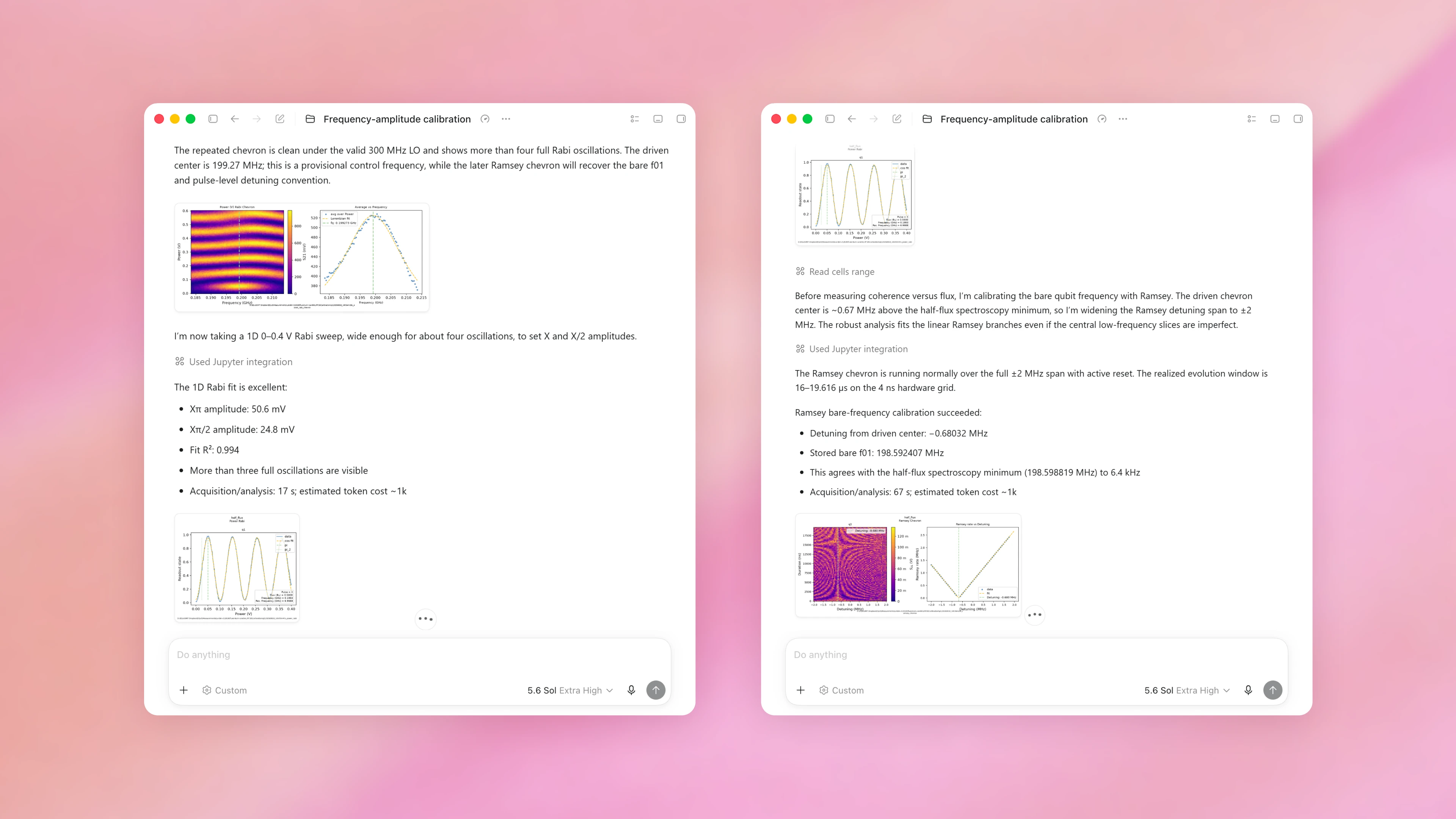
一次校准运行中GPT‑5.6 Sol思维链的节选。图片来源:EQuS小组
与研究人员协同工作
直接的优势在于,Codex代理可以帮助研究人员在实验分析和测量方面稳步推进,而无需持续监督。经验丰富的研究人员或许仍能比当前AI模型更快地确定最佳校准设置。但通过节省原本用于监控校准过程每一步的时间,研究人员可以专注于其他工作。
常规芯片表征遵循相对明确的工作流程。对于新颖实验,Yankelevich为Codex代理分配更窄的实验目标,同时更充分地利用它们编写、修改和测试用于控制、分析和模拟的新代码的能力。将代理直接连接到实验室,使该小组能够修改代码、针对真实测量进行测试,并自主完成更长时间段的工作。
“我已经建立了基础设施来引导代理完成我工作中的多个部分——测量、理论和芯片设计——现在这真的开始产生回报了,”Yankelevich说。“我可以同时让多个代理处理不同问题,而我将大部分时间花在更高层次的工作上——解读结果、设计实验、为代理规划下一步、阅读和写作。”
Quantum computing is an emerging technology that uses the unique properties of quantum mechanics to process information. It could one day better simulate complex materials and molecules. Unlike conventional processors, quantum processors are built with quantum bits, or qubits. Preparing and running qubit experiments can take months and require hundreds to thousands of preliminary measurements—work that AI is poised to help with.
Beatriz Yankelevich, a graduate student in MIT’s Engineering Quantum Systems Group (EQuS), used GPT‑5.6 Sol, harnessed to Codex, to explore whether AI could streamline her experimental workflow. The MIT group studies superconducting qubits, which are cooled to near absolute zero inside specialized devices called dilution refrigerators. These qubits perform operations quickly, are precisely controlled using microwave signals, and can be made using familiar manufacturing techniques and arranged on a chip.
Once a superconducting qubit chip has been fabricated, packaged, and cooled, researchers interact with it entirely through software, making Yankelevich’s experiments a natural testbed for AI agents. Connecting Codex to the lab software that coordinates experiments allowed it to run measurements, analyze the results, and decide what to try next. Yankelevich found that GPT‑5.6 Sol could often complete routine measurement workflows autonomously, saving her significant amounts of time and allowing experiments to run without constant supervision. This freed her to spend more time on analyzing results, designing experiments, and planning out the next steps in her research.
A packaged qubit chip (left) sits inside an open dilution refrigerator (right). CREDIT: EQuS group
Coordinating interdependent measurements
Superconducting qubits are often called artificial atoms because, like atoms, they can only occupy specific energy levels. Microwave pulses move qubits between these levels and probe their quantum state. Researchers design and calibrate the pulse sequences sent to the chip, then digitize and analyse the returning signals. These measurements reveal each qubit’s resonance frequencies, which allows researchers to accurately control the qubit; how long the qubit retains quantum information; and the settings needed to perform computations.
Calibrating qubits requires a series of interdependent measurements, with each result shaping what happens next. Qubit properties can occasionally drift, and unexpected physical behavior can cause inconsistent results. Experienced researchers can recognize these changes and adapt when they occur. This combination of software control, repeated measurements, and adaptive decision-making also makes qubit calibration a compelling use case for AI agents.
Yankelevich tested GPT‑5.6 Sol’s ability to run measurements on an uncalibrated six-qubit chip, one of a standard type that EQuS routinely uses to benchmark its fabrication process. She provided Codex with measurement-specific skills explaining how to run and evaluate each experiment. Using these skills and the chip’s design targets, GPT‑5.6 Sol chose measurement parameters, operated the hardware, analyzed the resulting data, and then either refined the measurement or saved the result for use in the next measurement.
When the signals were clear, Codex completed a standard sequence of measurements with little researcher intervention. It identified the qubit’s transition frequencies, calibrated the pulses used to control and read it, and determined how long the qubit retained quantum information.
GPT‑5.6 Sol had more difficulty when experimental signals were weak or noisy. In those cases, it took longer to find suitable measurement parameters and sometimes needed guidance from an experienced researcher. The results suggest that current agents can handle clearly defined experimental workflows, but interpreting ambiguous physical results remains a challenge.
EQuS fabricates many of these standard chips, each of which can take a researcher several days to characterize. The group now regularly uses agents to handle routine measurements, freeing researchers to focus on other work.
“I can have agents running measurements for many hours overnight or while I’m working in the cleanroom,” Yankelevich said. “I can check in from my phone, see what they’ve done, and steer them if something needs fixing or if I want to explore a different direction.”
An excerpted GPT‑5.6 Sol chain-of-thought from a calibration run. CREDIT: EQuS group
Working alongside researchers
The immediate advantage is that Codex agents can help researchers make steady progress on experimental analysis and measurements without constant supervision. Experienced researchers may still be able to identify the best calibration settings faster than current AI models. But by saving time previously spent on monitoring every step of the calibration process, researchers can focus on other work.
Routine chip characterization follows a relatively well-defined workflow. For novel experiments, Yankelevich assigns Codex agents narrower experimental goals while drawing more heavily on their ability to write, modify, and test new code for control, analysis, and simulation. Connecting agents directly to the lab lets the group revise code, test it against real measurements, and complete longer stretches of work autonomously.
“I’ve built infrastructure to guide agents through several parts of my work—measurement, theory, and chip design—and now it’s really starting to pay off,” Yankelevich said. “I can have multiple agents working on different problems at once, and I spend most of my time on higher-level work—interpreting results, devising experiments, planning next steps for the agents, reading, and writing.”
本文内容采集自官方网站,排版和翻译可能与原页面存在差异。
阅读官方全文