投资公司的优势是一笔一笔交易建立起来的,但每个决策背后的判断通常只存在于少数资深投资者的头脑中。当他们离开时,公司就会背上Terminal X(在新窗口中打开)所称的记忆债务:公司或许保留了文件,却失去了推理过程。
Terminal X的Capital Memory操作系统旨在偿还这笔债务。该公司的前置部署工程师——曾任职于摩根大通和黑石集团的金融与投资专业人士——与每位客户的投资团队同驻办公,设计公司的智能体架构,并将公司的投资方式编码进公司拥有的智能体中,部署在本地或自有云环境中。
包括GPT‑6.1 Sol和GPT‑6 Luna在内的OpenAI模型负责这些智能体内部的推理。Terminal X的Eval Agent则按照公司标准对智能体的输出进行评分。GPT‑6.1 Sol帮助Eval Agent多捕捉到约25%偏离基金授权范围的建议,并且以比次优模型低约30%的每次查询成本运行相同的工作流。
“GPT-6.1 Sol的长上下文推理能力和token效率使我们能够构建更深入的评估流水线。这帮助我们的Eval Agent让投资判断变得可衡量、可审计。”
——Hyun Hong,Terminal X联合创始人兼CEO
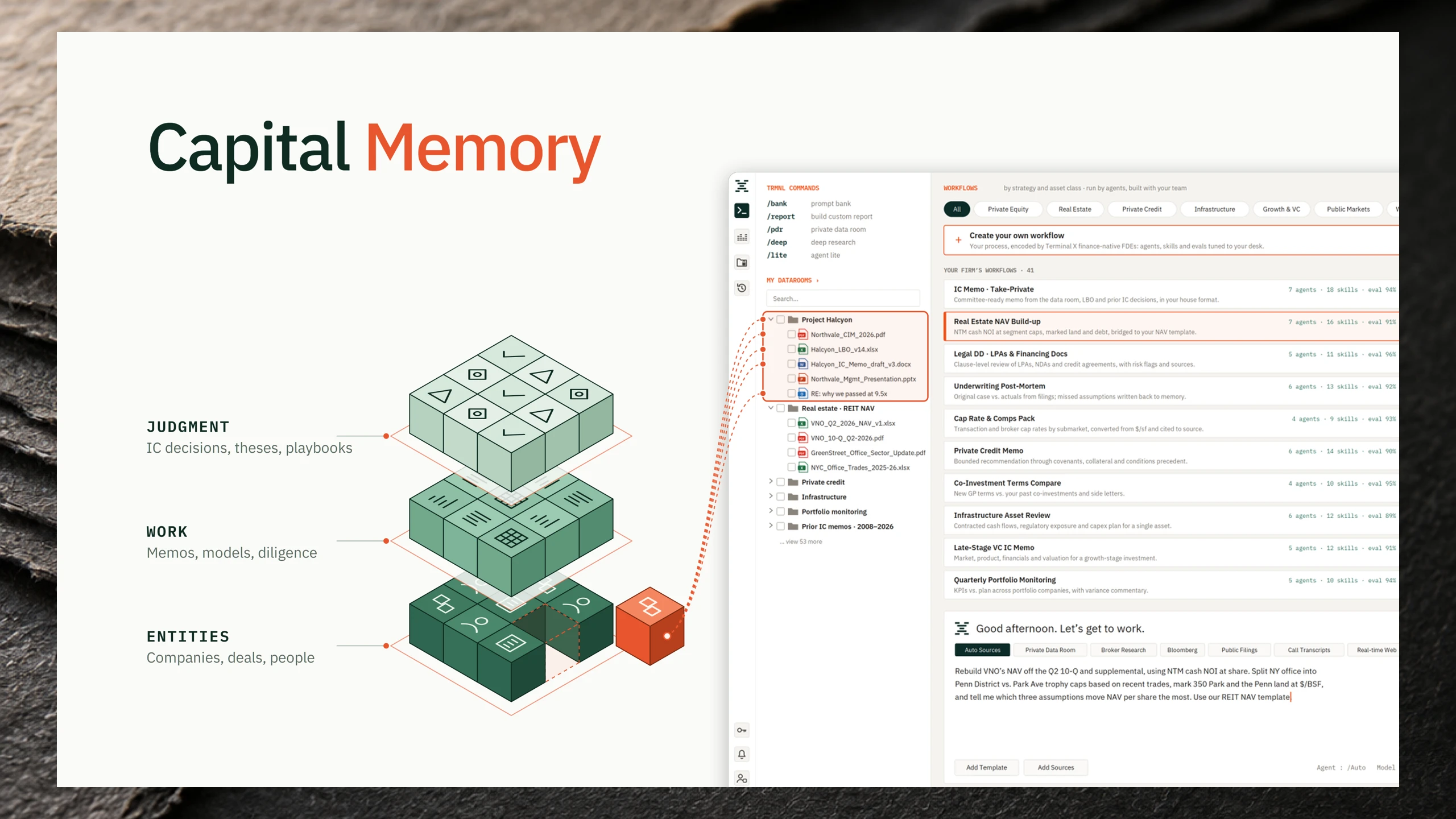
编码每家机构最优秀投资者的推理方式
Terminal X为每位客户构建的智能体,旨在按照该机构最优秀投资者的方式进行投资。Terminal X的工程师花数周时间驻场客户处,逆向工程公司可信的备忘录,并捕捉从未被写下的流程,例如信贷台如何筛选借款人,或联合投资团队在撰写备忘录前会调取哪些来源。
接下来,这些流程被编码进数百个智能体中,按资产类别和策略定制,并为每个投资阶段设置子智能体。GPT‑6.1 Sol处理需要判断力和超大上下文窗口的阶段:综合投资论点、识别关键考量因素,以及评估与公司授权范围的契合度。GPT‑6 Luna运行高频步骤,这些步骤中token效率比深度更重要。
这些智能体在每家公司的私有数据室中工作,这是一个供企业共享和管理敏感投资数据的专用环境。智能体处理英文、韩文、日文和中文文档,并将所学内容存储为机构Memory:一个记录某个部门如何做出某类决策的版本化记录,包括其过往分析、委员会决策、工作流指令和内部观点。
工程师将每个Memory转化为Terminal X平台上的可重复工作流,其中每次生产查询都可审计,并带有完整轨迹:所采取的步骤、检索的来源、使用的模型以及推理过程。
据Terminal X称,客户因这一方法实现了显著节省,其中一家私募股权公司报告称,通过自动化尽职调查和投资备忘录工作流,实现了240万美元的年化节省。
用Eval Agent为答案评分并改进系统
为了按照公司自身标准检查智能体的答案,Terminal X构建了Eval Agent。这是一个基于GPT‑6.1 Sol和其他OpenAI模型的编排工作流,旨在像副总裁审阅分析师工作那样阅读每个智能体的输出。
Eval Agent按照54项标准的评分细则检查每个输出。它会问:数字、可比公司、共识数据和引文是否来自正确的来源?叙述是否成立?建议是否与内部观点一致?
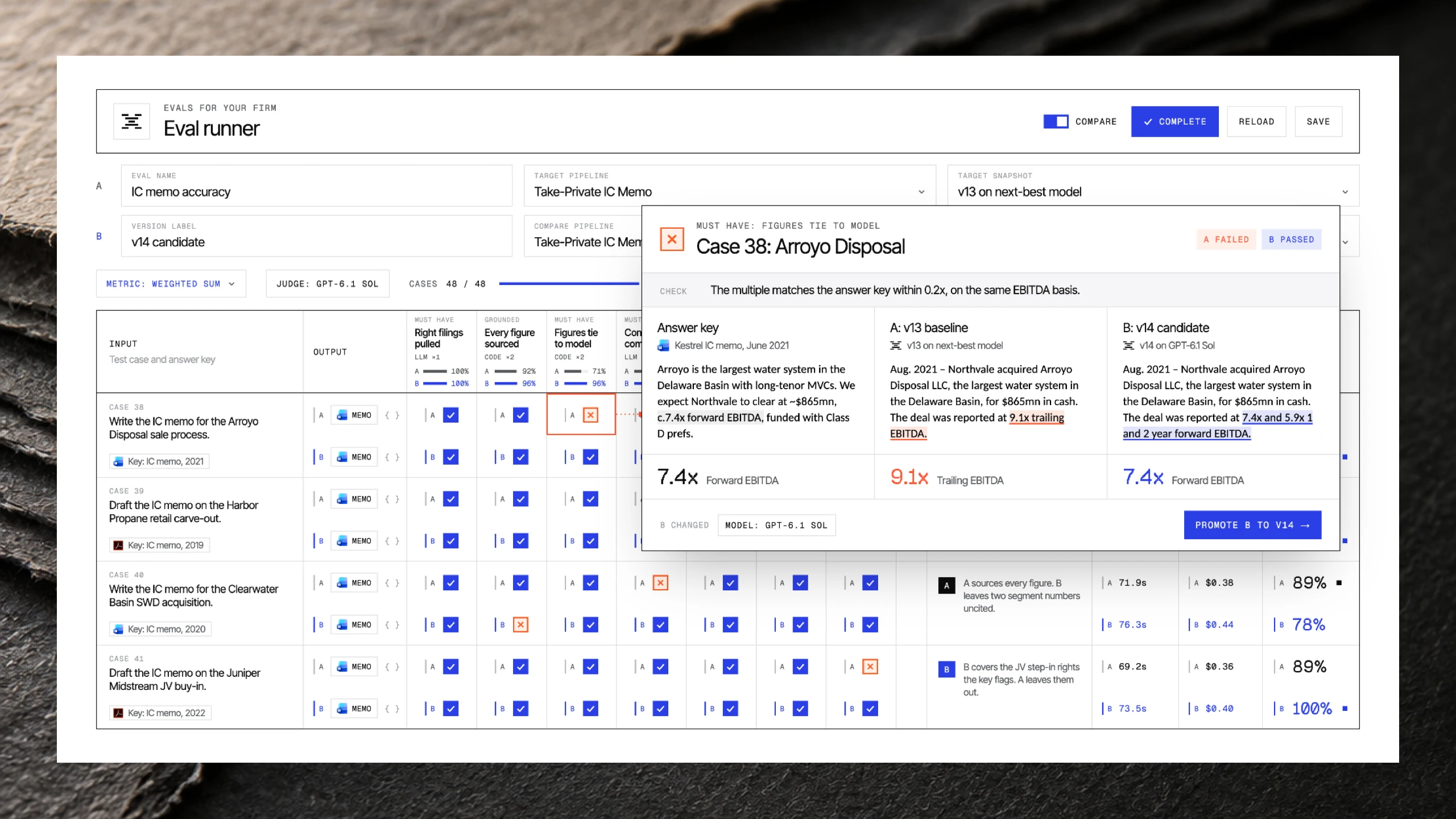
每项检查评分为通过或失败。每次失败都包含一行原因以及更好的来源或更正后的文本,并成为一个Memory。例如,遗漏的来源、错误的可比公司,或偏离内部观点的论点,都会被编码为该部门的新工作流指令或新测试用例。
“每个答案都会被评估,分析师纠正的任何内容都会让系统更多地了解那家公司如何运作,”Terminal X联合创始人兼CTO Ken Lee说。“因此,一家公司使用得越久,它就越像他们自己的团队那样思考。”
测试每个模型,按任务选择
Terminal X根据自身的评估结果选择模型。在500项评分判断中,其基于GPT‑6.1 Sol的Eval Agent与资深人类评审员的一致率为88.6%,而次优模型为86.4%,提升了220个基点。
GPT‑6.1 Sol表现更优的一类错误是风格漂移。例如,一家收购基金的授权范围是寻找以低于NAV折价交易的私有化候选公司,承销业务并安排融资结构。当情景模型暗示市场转向时,交易开始推荐不良信贷头寸或救助融资。基于GPT‑6.1 Sol的Eval Agent比次优模型多捕捉到约25%的此类偏离。
GPT‑6.1 Sol在长上下文工作中的token效率使Terminal X能够在相同预算内构建更深入的审查工作流。论点首先对照基金授权范围进行测试,然后对照其近期交易进行测试。不确定的判定会被重新运行,智能体在报告前会对结果进行核对。
这种更深入的审查标记出了在可比模型上单次运行会放行的交易。GPT‑6.1 Sol还以比次优模型低约30%的每次查询成本运行相同的工作流,速度相近。
迈向每位投资者的Memory
使用GPT‑6.1 Sol和GPT‑6 Luna,Terminal X已构建1,700个机构Memory,运行超过100万个定制工作流,周活跃用户数达到月活跃用户数的81%。
Terminal X的下一步是将机构Memory从部门扩展到个人,以便每位投资专业人士的标准在其实践中被捕捉,而不仅仅是在其描述中被捕捉。
对于Terminal X联合创始人兼CEO Hyun来说,这正是关键所在:“赢得下一个十年的公司将把自己的判断作为数据来拥有。我们的工作是让这种判断可衡量,从而能够被保留、改进和复用。”
An investment firm’s edge is built deal by deal, but the judgment behind each decision usually lives in the heads of a few senior investors. When they leave, the firm takes on what Terminal X(opens in a new window) calls memory debt: the firm may keep the documents, but it loses the reasoning.
Terminal X’s Capital Memory operating system is designed to pay that debt down. The company’s forward-deployed engineers, former finance and investment professionals at JPMorgan and Blackstone, sit with each customer’s investment teams, design the firm’s agentic architecture, and encode how the firm invests into agents the firm owns, deployed on-premise or in its own cloud.
OpenAI models, including GPT‑6.1 Sol and GPT‑6 Luna, handle the reasoning inside those agents. And Terminal X’s Eval Agent grades the agents’ output against the firm’s standards. GPT‑6.1 Sol helped the Eval Agent catch about 25% more recommendations that strayed from a fund’s mandate and ran the same workflows at approximately 30% lower cost per query than the next-best model.
“GPT-6.1 Sol’s long-context reasoning and token efficiency allow us to build deeper evaluation pipelines. This helps our Eval Agents make investment judgment measurable and auditable.”
—Hyun Hong, Co-founder and CEO, Terminal X
Encoding the reasoning of each firm’s best investors
For each customer, Terminal X builds agents designed to invest the way the firm’s best investors do. Terminal X engineers spend weeks onsite with the customer, reverse-engineering the firm’s trusted memos and capturing processes that were never written down, such as how the credit desk screens a borrower or which sources the co-investment team pulls before a memo.
Next, those processes are encoded in hundreds of agents, customized by asset class and strategy, with sub-agents for each investment stage. GPT‑6.1 Sol handles the stages that require judgment and a huge context window: synthesizing the investment thesis, identifying key considerations, and assessing fit with the firm’s mandate. GPT‑6 Luna runs the high-volume steps where token efficiency matters more than depth.
The agents work inside each firm’s private data room, a dedicated environment for enterprises to share and manage sensitive investment data. The agents process documents in English, Korean, Japanese, and Chinese, and store what they learn as a firm Memory: a versioned record of how one desk makes one kind of decision, including its past analyses, committee decisions, workflow instructions, and house views.
Engineers turn each Memory into a repeatable workflow on Terminal X’s platform, where every production query is auditable with its full trail: the steps taken, sources retrieved, model used, and the reasoning.
According to Terminal X, customers see significant savings as a result of this approach, including one private equity firm that reported $2.4 million in annualized savings from automated due diligence and investment memo workflows.
Scoring answers with an Eval Agent and improving the system
To check agents’ answers against the firm’s own standard, Terminal X built an Eval Agent. It’s an orchestrated workflow on GPT‑6.1 Sol and other OpenAI models designed to read every agent output the way a VP reads an analyst’s work.
The Eval Agent checks each output against a 54-criterion rubric. It asks: Are the numbers, comps, consensus figures, and quotes pulled from the right sources? Does the narrative hold? Does the recommendation tie to the house view?
Each check scores pass or fail. Every fail includes a one-line reason and a better source or corrected text and becomes a Memory. For example, a missed source, a wrong comparable, or a thesis that drifts from the house view is encoded as a new workflow instruction or a new test case for that desk.
“Every answer gets eval’d, and whatever the analyst corrects teaches the system a little more about how that firm works,” says Ken Lee, Co-Founder and CTO of Terminal X. “So the longer a firm uses it, the more it thinks like their own team.”
Testing every model, choosing by task
Terminal X picks models based on its own evaluation results. Across 500 scored judgments, its Eval Agent on GPT‑6.1 Sol agreed with the senior human reviewer 88.6% of the time, vs. 86.4% for the next-best model, an improvement of 220 basis points.
One class of error where GPT‑6.1 Sol outperformed is style drift. For example, a buyout fund’s mandate is to find take-private candidates trading at a discount to NAV, underwrite the business, and structure the financing. When scenario models suggest a market turn, deals start recommending a distressed credit position or a rescue financing. The Eval Agent on GPT‑6.1 Sol caught about 25% more of these departures than the next-best model did.
GPT‑6.1 Sol’s token efficiency on long-context work enabled Terminal X to build a deeper review workflow within the same budget. The thesis is tested first against the fund’s mandate, then against its recent deals. Uncertain verdicts are re-run, and the agent reconciles the results before reporting.
That deeper review flagged deals that a single pass on a comparable model had waved through. GPT‑6.1 Sol also ran the same workflows at about 30% lower cost per query than the next-best model, at similar speed.
Moving toward a Memory for every investor
Using GPT‑6.1 Sol and GPT‑6 Luna, Terminal X has built 1,700 firm Memories, run more than 1 million custom workflows, and reached a weekly active user count equal to 81% of its monthly active users.
Terminal X’s next step is to extend firm Memories from desks to individuals, so that each investment professional’s standard is captured as it is practiced, not only as it is described.
For Hyun, co-founder and CEO of Terminal X, that is the point: “The firms that win the next decade will own their judgment as data. Our job is to make that judgment measurable, so it can be kept, improved, and reused.”
本文内容采集自官方网站,排版和翻译可能与原页面存在差异。
阅读官方全文