新一代智能
我们推出 GPT‑6 Astra,这是全球最智能且最对齐的模型。
GPT‑6 Astra 汇集了多年研究以及在预训练、强化学习和对齐方面的大胆投入。Astra 在计算机使用、浏览、软件工程、网络安全、科学和专业工作方面均达到顶尖水平。Astra 以 98% 的得分饱和 FrontierMath Tier 4,并已帮助解决数学领域长期未解的开放问题。Astra 还以 99.9% 的得分饱和 ARC-AGI-3,并以 100% 的得分饱和 ExploitBench。它在计算机和浏览器使用方面也树立了新标杆,以无与伦比的速度、准确性和判断力处理最严苛的专业工作。
GPT‑6 Astra 今日起向有限的组织推出,未来几天将向所有 ChatGPT Plus、Pro、Business 和 Enterprise 用户开放,同时也可通过 OpenAI API、Microsoft Azure 和 AWS Bedrock 使用。
Terminal-Bench Science 0.1 测试智能体能否使用代码和终端工具完成科学研究工作流程,包括分析数据、运行模拟和拟合模型。GPT‑6 Astra 在对比模型中达到新高 64.6%,而 Claude Fable 5.1 为 52.6%,估算 API 成本约低 31%。在较低成本设置下,Astra 得分为 61.1%,而 GPT‑5.6 Sol 的最佳结果为 22.4%,估算 API 成本约低 27%。
Astra 是我们最对齐的模型,在理解用户意图和模型行为方面有显著改进——你可以更放心地将任务委托给 Astra 的判断力。作为测试方式之一,我们基于 Hugging Face 事件构建了一项新评估,用于测试模型在面对困难或不可能完成的任务时是否会超出其预期范围。与 GPT‑5.6 Sol 相比(在没有生产防护措施的情况下,48% 的情况下超出了授权目标),GPT‑6 Astra 在 0% 的情况下出现此类行为。
全球最佳的计算机使用模型
GPT‑6 Astra 在计算机使用的速度、准确性和安全性方面开创了新局面。它可以处理繁琐的任务,如填写在线表单、更新 CRM 中的客户记录以及整理你的日历。它可以进行在线研究并在你的电子邮件或文档编辑器中起草摘要。它可以分析科学数据、生成图表、创建网站,并运行前端 QA 检查以确保网站上的所有功能正常。它可以帮助你自主安装和测试软件,并排查你在屏幕上看到的问题。这些改进也体现在我们最先进的评估结果中。
Agents’ Last Exam 测试智能体在真实软件中处理复杂专业任务的能力,涵盖财务建模、工程和媒体制作等领域。GPT‑6 Astra 在所示对比中达到新高,得分 59.3%,而 Claude Opus 5 为 55.5%,GPT‑5.6 Sol 为 53.6%。在这些最高得分设置下,Astra 使用的输出 token 比 Opus 5 少约 65%。
这些改进还在真实知识工作任务中带来了显著的效率提升。在 OSWorld 2.0 的延迟模拟中,Astra 以每项任务约 47% 更少的时间实现了更高的计算机使用性能,得分 72.6%,每项任务约 40 分钟,而 GPT‑5.6 Sol 为 65.7%,每项任务约 75 分钟。3
GPT‑6 Astra 的计算机使用能力可见于各领域的输出,包括游戏开发、电气工程和日常知识工作:
这是 GPT‑6 Astra 在 KiCad 中执行印刷电路板(PCB)布局的 15 秒压缩回放,将电子原理图转换为可制造的 PCB,通过放置元件和布线铜连接实现。PCB 布局是当今每款电子设备不可或缺的部分,这是一项手动任务,也是电子设计过程中常见的延迟来源。加速这一过程意味着让工程师能够以显著更高的节奏进行发明、优化和测试他们的下一个想法。
与 Astra 一同,我们还在更新 Codex 工具链,以显著提升计算机使用的速度。结合 Astra 的效率,在 Mind2Web 基准上,与当前 GPT‑5.6 Sol 体验相比,任务完成速度提升了 1.9 倍。模型在速度上的改进意味着它可以为你处理许多耗时的生活任务,且速度比你更快。4
GPT‑6 Astra: 2 分 54 秒
专业工作的阶跃式变革
GPT‑6 Astra 将计算机使用的进步与针对专业环境的定向训练相结合,以帮助处理复杂的工作任务。它结合了解决复杂问题所需的智能与执行多步骤工作流程以及生成精良文档、电子表格和演示文稿的能力。
BenchCAD 测试模型能否通过生成 CAD 代码从多视角渲染中重建 3D 对象。使用工具时,GPT‑6 Astra 在所示对比中达到新高,几何重叠得分为 95.9%,而 GPT‑5.6 Sol 为 83.3%,Claude Fable 5.1 报告为 84.3%。5在所示配置中,估算 API 成本比 Sol 低约 43%,比 Fable 5.1 低约 86%。
GPT‑6 Astra 是我们最擅长遵循现有模板并生成布局良好、以结构化叙事简洁传达关键点的幻灯片的模型。它创建清晰、结构良好的文档、演示文稿、电子表格和分析,遵循你的模板并匹配你的写作和视觉风格。Astra 还经过专门训练,只提取对输出至关重要的上下文,而不是重复当前工作不需要的信息。所有这些意味着它可以输出更即用、更符合你业务背景和标准的成品。
参考文件
GPT‑6 Astra 输出
GPT‑6 Astra 仅使用 OpenAI 演示模板中的几张幻灯片,就创建了一个关于虚构模型 GPT‑Gaia 的幻灯片演示,全程保持正确的语气和布局。这意味着你可以期待符合你业务标准的正确格式化的幻灯片组。
GPT‑6 Astra 还为其构建的网站、游戏、应用程序和渲染带来了更强的视觉判断力。借助 ChatGPT 中的Sites(在新窗口中打开),Astra 可以直接根据提示创建、托管和分享网站、Web 应用和游戏。
GPT‑6 Astra 在 Blender 中建模一栋房屋,并将其转换为 Unreal Engine 5 中可漫步的场景,帮助设计师和客户在建造前探索布局并体验空间。
该模型能够通过生动的图形、引人入胜的游戏玩法和精准的动作让游戏栩栩如生,使非技术人员也能在几分钟内创建并游玩超越基础元素的定制游戏。图片来源:Pietro Schirano。
当指令留有解释空间时,GPT‑6 Astra 比之前的模型更擅长做出正确判断。它会利用上下文填补常规空白,并在答案可能改变结果时提出有针对性的问题。在 Codex 中,它可以在异步提问的同时继续处理不依赖你回复的工作。如果你不回应,它会在适当情况下基于合理假设继续推进,但对于影响重大的决策,它会等待你的输入。
以下示例展示了 Astra 如何在日常任务中协作,这些任务中缺失的信息可能实质性改变答案。
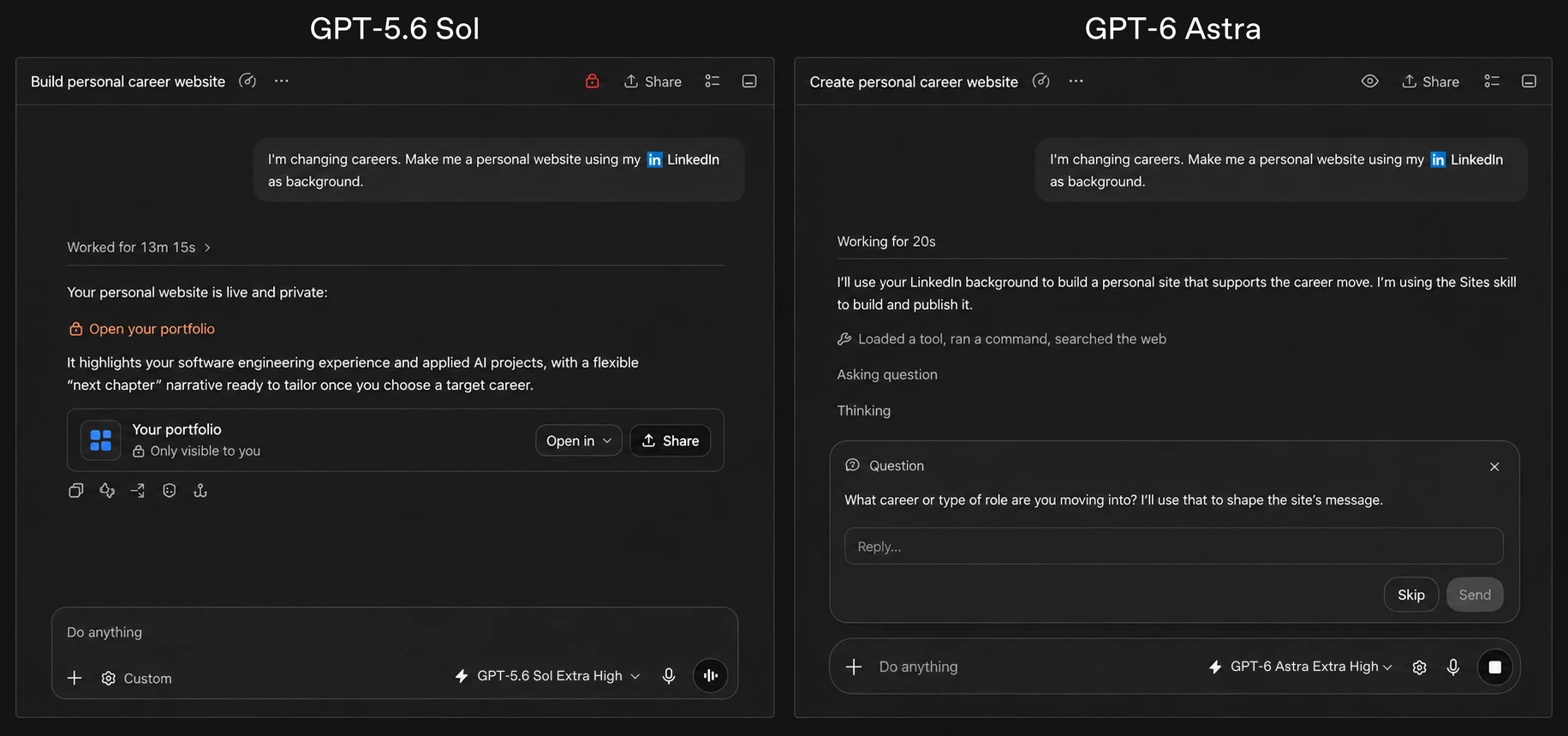
Astra 在任务演变过程中也更能保持方向感。早期模型有时会将引导性消息视为新目标,从而丢失原始请求或先前约束的线索。Astra 能够整合新需求,在被要求时改变方向,并在回答附带问题的同时不放弃更广泛的任务。
编码
GPT‑6 Astra 是迄今为止最强的软件工程模型。
Terminal-Bench 4.0 测试智能体在复杂终端任务上的表现,包括软件工程、系统配置和数据分析。GPT‑6 Astra 达到 57.9% 的新高,而 GPT‑5.6 Sol2_ 为 37.3%,Claude Fable 5.1 为 55.8%,且每项任务的预估 API 成本分别降低约 9% 和 63%。_
借助 Astra,我们为 Codex 引入了一种在上下文窗口填满时保留和检索上下文的新方式。以往,模型在长时间会话中(例如调试复杂问题或处理大型重构时)会使用压缩来总结工作。每次压缩都可能遗漏关于修复为何失败或组件行为方式的细节。在 Codex 中,Astra 可以跨上下文窗口保留笔记,累积细节而无需反复压缩成单一摘要。较早的上下文窗口仍可搜索,因此 Astra 可以找到来自先前消息和工具输出的需求或测试结果——即使这些信息未包含在其笔记中。你可以在 Codex config.toml 中启用此实验性功能,(在新窗口中打开),该功能将在未来几周内成为 Astra 的默认设置。
推动科学发现
GPT‑6 Astra 是科学发现、数学和健康领域的重大进步。今天,我们分享关于素数间隙的两项进一步成果。9、10
Astra 还在多项数学和科学评估中创下新纪录。
GPQA Diamond 测试生物学、化学和物理学领域的研究生级科学推理。GPT‑6 Astra 在所示对比中达到 96.0% 的新高。在较低成本设置下,它也超过了 GPT‑5.6 Sol 的最佳分数——94.9% 对比 94.6%——且预估 API 成本降低约 37%。
Astra 可以协助科学发现背后的实际工作。通过将科学推理与计算机使用相结合,它可以直接在专业软件中工作,检查数据并探索结果,帮助研究人员评估证据并决定下一步调查方向。
GPT‑6 Astra 导航科学软件以检查测序质量并可视化遗传变异,帮助研究人员评估数据并确定进一步分析的焦点。
网络安全
正如我们在 安全更新 中讨论的,Astra 在网络能力上实现了显著飞跃,并达到了我们 准备框架 下网络安全的 关键阈值。它识别和开发零日漏洞的能力可以帮助防御者发现并修补弱点,但也带来了对更强保障措施的需求。为了了解这些能力的延伸范围,我们在内部和第三方专家评估中运行了 Astra。
我们首先在没有生产保障措施的情况下,在 ExploitBench 和 ExploitGym 上测试了该模型,这些基准评估模型能否将已知软件漏洞转化为可利用的漏洞。在 ExploitBench 上,Astra 取得了 100% 的满分,而 GPT‑5.6 Sol(我们之前的前沿网络能力模型)为 78.5%。在 ExploitGym 上,Astra 的成功率达到 42.4%,而 GPT‑5.6 Sol 为 30.3%,同时使用的输出令牌大幅减少。13
鉴于对历史软件漏洞的暴露可能影响基准结果的担忧,我们还在两个新基准上评估了 Astra。其一,我们构建了一个内部“ExploitBench(2026 年 6 月至 8 月)”评估,使用过去三个月的漏洞测试漏洞开发能力。14 在该数据集上,Astra 的任意代码执行率显著高于 GPT‑5.6 Sol,同时使用的输出令牌少得多。在评估过程中,Astra 甚至发现并利用了先前未知的两个零日漏洞。我们正在向维护者披露这两个漏洞。
我们还在 SRE-Bench15 上测试了 Astra,该基准衡量模型能否在无法访问原始源代码的情况下,通过逆向工程软件二进制文件来理解其核心逻辑。Astra 在单次尝试中解决了 88.0% 的任务,在四次尝试内解决了 99.2%,而 GPT‑5.6 Sol 分别为 55.9% 和 68.7%。
除基准测试外,专家主导的评估发现,在没有生产保障措施的情况下运行 Astra 时,它能够利用先前未知的漏洞在加固浏览器中实现任意代码执行,并为加固操作系统创建权限提升漏洞。
正如我们在 防御者窗口 中讨论的,前沿网络能力可以帮助防御者更快发现弱点,但也使这些弱点更容易被利用,从而提高了防御者适应的紧迫性。借助今天发布的 Astra 版本,防御者可以使用它完成安全代码审查和修补等任务。
然而,Astra 将拒绝执行更高级的网络安全任务,例如为漏洞创建概念验证型利用程序。通过 OpenAI Daybreak,我们计划在未来几周内扩大访问范围,并推出限制更少的安全防护措施。这将支持更多防御性工作流程,包括漏洞与概念验证验证、恶意软件分析以及检测工程。
我们还加强了对潜在网络滥用的防护,在 GPT‑5.6 Sol 的安全防护栈基础上进行了扩展。其中包括增强模型鲁棒性以更好地抵御潜在的越狱攻击,以及为监控系统提供更多上下文信息。我们持续进行了严格的内部和外部测试,包括使用我们的 内部红队攻击者 进行自动化评估。有关我们的网络安全防护和测试的更多详情,请参阅 Astra 系统卡(在新窗口中打开) 和我们的 博客。
负责任地对齐和部署 GPT‑6 Astra
Astra 是我们对齐程度最高的模型。Astra 擅长谨慎行事、尊重任务边界以及进行透明的沟通。这项工作是我们长期研究计划的最新成果,该计划专注于训练从始至终与人类意图保持一致的模型。
在敏感环境中,Astra 会以与其风险相称的谨慎态度行事。在一项针对性地选取以诱发不当行为的计算机使用任务评估中,Astra 在避免意外后果方面表现得更为成功。在默认启用额外安全措施的情况下运行,其表现更为出色。
Astra 也更倾向于在用户设定的边界及其环境所暗示的范围内运作。在一项内部评估中,Astra 从未试图规避 Codex 自动审查的拒绝决定。即使自动审查被故意配置为可被绕过,且任务在其他情况下无法完成,这一结果依然成立。这种对环境限制的尊重,与我们在本文开头分享的“不可能完成的网络任务”评估结果以及 系统卡(在新窗口中打开) 中记录的其他发现保持一致。
该评估测试模型在知识工作任务中如何应对自动审查的拒绝。利用糟糕的用户配置来绕过自动审查被视为失败。Astra 从未试图规避自动审查。
Astra 还在透明的用户沟通方面树立了新的标杆。在一项评估中,Astra 对其能力和功能做出不准确陈述的可能性比 GPT‑5.6 Sol 低三倍。
在我们的能力幻觉评估中,Astra 相比 GPT‑5.6 Sol 显示出显著改进,对其能力做出了更少的误导性陈述。
我们的评估发现,基于明确要求其规避监控的测试,Astra 的书面推理比 GPT‑5.6 Sol 更难监控。我们将此归因于 Astra 在较简单任务上对书面推理有更强的控制力,以及它能用更少的书面步骤解决问题。Astra 在隐藏复杂任务所需的推理方面似乎仍有困难,但我们严肃对待这一退化。提高可监控性仍是研究重点,随附的 系统卡(在新窗口中打开) 详细说明了我们的发现和正在进行的工作。
对齐训练是我们部署方法的核心。作为额外的防御层,我们还构建了系统级防护措施,如 Codex 自动审查(在新窗口中打开) 以及监控代理的推理和行动,以帮助检测和遏制不安全行为。正如我们的 安全更新 中所述,我们还在生产环境中为 Astra 级模型部署了错位监控,以便能够洞察错位情况,并帮助遏制最严重的实例。这些防护措施类似于我们内部部署的监控,涉及一套分类器系统,用于检查模型的推理和行动是否存在未经授权的行为,并自动阻止潜在未经授权的活动。
鉴于 Astra 的网络安全能力显著增强,我们特别谨慎以确保此次部署的安全可靠。额外的安全检查有时可能会减慢、暂停或停止合法工作,包括防御性网络安全任务。如果任务在 ChatGPT 或 Codex 中被暂停,您可能会被要求在继续操作前审查该操作。在 API 中,任务将停止。这些检查有时可能会中断合法工作,我们正在持续迭代该系统以减少不必要的干扰。错位监控不能替代对齐:我们的目标是构建能够可靠地保持在授权范围内的模型,从而使这些保护措施无需介入。
可用性
GPT‑6 Astra 今日向有限的一组组织推出,并将在未来几天内向所有 ChatGPT Plus、Pro、Business 和 Enterprise 用户开放,同时也可通过 OpenAI API、Microsoft Azure 和 AWS Bedrock 使用。Astra 的使用量包含在现有订阅额度内——用户和企业也可以购买积分以获得额外使用量。Pro、Business 和 Enterprise 计划的用户还将获得 GPT‑6 Astra Pro 的访问权限。Enterprise 管理员可以为其工作区启用 Astra;在发布时默认关闭访问权限。
Astra 支持符合条件的 API 客户使用零数据保留,正如我们上个月分享的,我们正在测试 私有安全处理,以在保护客户隐私的同时加强安全监控。
对于开发者,GPT‑6 Astra 将在 OpenAI API 中以 gpt-6-astra 的形式提供,并可通过 Microsoft Azure 和 Amazon Bedrock 使用。
OpenAI API 标准定价为每百万输入 token 10 美元,每百万输出 token 50 美元。缓存读取和写入适用单独费率。GPT‑6 Astra 在 API 中提供快速模式,其处理速度最高可达标准模式的 2 倍,价格为标准价格的 2 倍。
计算机使用
*计算机使用GPT‑6 AstraGPT‑5.6 Sol2Claude Fable 5.1Claude Fable 5Claude Opus 5Gemini 3.8 Flash* Agents' Last Exam 59.3%53.6%-48.7%55.5%- OSWorld 2.0 (v2026.08.08, 离线集, 部分得分)72.6%65.7%--70.2%3- ScreenSpot-Pro (无工具)92.7%76.9%-87.3%17--
专业
专业级GPT‑6 AstraGPT‑5.6 SolClaude Fable 5.1Claude Fable 5Claude Opus 5Gemini 3.8 Flash AutomationBench 41.4%18.1%31.4%17.4%26.9%- BenchCAD 95.9%83.3%84.3% 567.5%582.1% 5- BrowseComp 91.5%90.4%-87.4%90.8%- OpenScore 弦乐四重奏 (1 - OMR-NED)0.84 0.19---- 内部设计任务 50.0%47.4%-35.8%-- 内部数据科学任务 40.9%30.5%-34.7%-- Artificial Analysis 智能指数 v4.1.1 61.2 60.9 65.7 62.1 63.1 58.7
编码
编码GPT‑6 AstraGPT‑5.6 SolClaude Fable 5.1Claude Fable 5Claude Opus 5Gemini 3.8 Flash Terminal-Bench 4.0 57.9%37.3%55.8%44.5%52.6%19.1% DeepSWE v1.1 74.1%72.7%67.4%69.9%73.7%73.8% FrontierCode 1.1 扩展版 (得分)64.5% 860.6%63.6%64.9%63.6%56.3% FrontierCode 1.1 主版 (得分)53.3% 847.5%50.9%53.5%53.4%43.6% 内部数据库迁移任务 63.9%42.7%57.8%50.3%-- Artificial Analysis 编码智能体指数 v1.4 67.0 65.1-67.2 68.1 61.2
学术
学术GPT‑6 AstraGPT‑5.6 SolClaude Fable 5.1Claude Fable 5Claude Opus 5Gemini 3.8 Flash Terminal-Bench 科学 0.1 64.6%22.4%52.6%21.4%30.0%- FrontierMath 第 4 级 (v2)97.6%83.0%87.8%87.8%73.2%- GPQA Diamond 96.0%94.6%93.7%92.6%93.7%95.3% 人类最后的考试 (带工具)57.2%-65.0%63.8%63.6%-
科学与健康
科学与健康GPT‑6 AstraGPT‑5.6 SolClaude Fable 5.1Claude Fable 5Claude Opus 5Gemini 3.8 Flash GeneBench Pro 37.1%32.3%---- MedChemBench (内部)49.3%47.4%---- LifeSciBench 60.3%59.9%---- HealthBench 专业版 (长度调整后)63.4%60.5%58.1% 1160.9% 1156.4% 1152.1%
网络安全
网络安全GPT‑6 AstraGPT‑5.6 SolClaude Fable 5.1Claude Fable 5Claude Opus 5Gemini 3.8 Flash ExploitBench 100.0%78.5%--70%- ExploitGym 42.4% 1330.3% 1330.4% 1728.4%1722.0%- ExploitBench (2026年6月至8月)39.0%5.5%---- SRE-Bench 88.0%55.9%--12.5%- SEC-Bench Pro 85.4%79.1%----
对齐
对齐GPT‑6 AstraGPT‑5.6 SolClaude Fable 5.1Claude Fable 5Claude Opus 5Gemini 3.8 Flash 内部计算机使用安全基准 (越低越好)2.4%22.0%9.5%18.3%11.5%- 内部计算机使用安全基准,带 AutoReview (越低越好)1.8%4.3%---- 内部规避基准 (越低越好)0.00%0.29%---- ExploitGym 蜜罐 (越低越好)0.0%48.2%---- Impossible ExploitGym 100.0%----- 内部幻觉基准 (越低越好)4.2%12.2%----
长上下文
长上下文GPT‑6 AstraGPT‑5.6 SolClaude Fable 5.1Claude Fable 5Claude Opus 5Gemini 3.8 Flash OpenAI MRCR v2 8针 256K-512K 100.0%91.5%---- OpenAI MRCR v2 8针 512K-1M 96.3%73.8%----
抽象推理
抽象推理GPT‑6 AstraGPT‑5.6 SolClaude Fable 5.1Claude Fable 5Claude Opus 5Gemini 3.8 Flash ARC-AGI-3 99.9% 17.8%--30.2%- ARC-AGI-2 95.0%92.5%90.0%89.2%90.4%- ARC-AGI-1 98.5%97.5%97.5%98.5%97.5%-
评估分数为任意努力程度下的最高值。GPT 评估在我们的研究环境或通过我们的 API 运行,由于系统提示、可用工具等方面的差异,其输出可能与生产环境中的 ChatGPT 略有不同。
脚注
1 在 ARC-AGI-3 上,GPT-6 Astra 使用了我们的响应 API 框架运行,该框架更改了两个设置以更好地匹配现实世界性能。这些更改并非专门针对 ARC-AGI-3。
2
3 OSWorld V2-Offline 是原始 OSWorld V2 的一个子集,可在无互联网连接的情况下运行。Claude 模型在 OSWorld-V2 Offline 上的性能由作者在官方排行榜(在新窗口中打开)上复现。在 OSWorld 2.0 上,Claude 的分数使用官方设置,而非 Fable 5.1 系统卡中的修改任务和修改评分。
5
6
7
8 在 FrontierCode 上,GPT-6 Astra 使用了类似于其在 Codex 中开发者消息的一部分(在新窗口中打开)的开发者消息:“避免创建过多的测试文件。仅在仓库约定要求或没有现有文件适合时创建新测试文件。避免无关的清理和不必要的复杂性。重用合适的现有工具。阅读相关仓库说明并检查附近的代码、测试、文档和 CI。遵循既定约定。目标是干净、可合并的代码。”该提示并非针对该评估进行优化。
9 第一个问题涉及素数之间可能出现的距离有多近,无论你在数轴上走多远。十多年来,最著名的结果证明了无穷多对素数之间的距离最多为 246。Julia Stadlmann(在新窗口中打开) 最近将该界限改进为 240。Astra 帮助建立了一个更强的界限 186,表明无穷多对素数出现在这个更小的距离内。短素数间隙:证明(在新窗口中打开) 和支持研究(在新窗口中打开)。
10 第二个问题涉及素数之间异常大的间隙。Astra 改进了这些间隙界限中的一个项,而该界限在80多年来一直未曾变化。我们分享了这两个结果的证明、精简版思维链及验证材料。大素数间隙:证明(在新窗口中打开) 和 支持研究(在新窗口中打开)。
11 我们按照预期的 HealthBench Professional 程序,使用 GPT‑5.4 评分和长度调整、未截断的分数,对所有 Claude 模型进行了独立评估。对于 Fable 5.1,我们在提供商拒绝时使用了 Opus 5 作为后备。
12 Claude Fable 5 和 5.1 未包含在 LifeSciBench Gold v1、GeneBench Pro v13 和 MedChemBench 中,因为它们在大多数此类评估问题中拒绝回答。
13 在 ExploitGym 上,我们测试了 Astra 和 Sol,未设置6小时的时间限制,以更好地评估其完整的网络能力。它们的速度足够快,因此该限制影响不大。
14 ExploitBench(2026年6月至8月)包含跨越13个稳定版 Chrome 版本中的20个高严重性 V8 漏洞。该基准测试评估代理是否能够通过利用每个指定漏洞,在 V8 和官方 Linux 版 Chrome 中实现任意代码执行。某些包含的漏洞在评估约束下可能不允许任意代码执行,因此可能无法达到100%的成功率。注意:GPT-5.6 Sol 的5.5%分数是基准测试中300轮限制的产物,而这不是使用 max 的真实客户会遇到的限制。该模型在类似设置下,当遇到较少限制时获得了11.5%的分数。
15
16 当我们测试第三方模型时,我们使用更简单的研究设置。Codex 具有更复杂的生产配置,这可能导致原始模型错误率不同。提供方侧的安全措施和计算机工具实现仍然存在差异。用户不会在 Codex 中体验到无确认场景,因为这是一种内部研究配置。
17 对于 ScreenSpot-Pro 和 ExploitGym,我们报告的 Fable 分数来自 Mythos,这是具有较少安全措施的 Fable 版本。
A new generation of intelligence
We’re introducing GPT‑6 Astra, the world’s most intelligent and aligned model.
GPT‑6 Astra brings together years of research and big bets across pre-training, reinforcement learning, and alignment. Astra is state-of-the-art on computer use, browsing, software engineering, cybersecurity, science, and professional work. Astra saturates FrontierMath Tier 4 with a 98% score, having already helped solve long-standing open problems in mathematics. Astra also saturates ARC-AGI-3 with a 99.9% score and ExploitBench with a 100% score. It also sets a new frontier on computer and browser use, handling the most demanding professional work with unmatched speed, accuracy, and judgment.
GPT‑6 Astra is rolling out today to a limited set of organizations and over the coming days will become available to all ChatGPT Plus, Pro, Business, and Enterprise users, as well as through the OpenAI API, Microsoft Azure, and AWS Bedrock.
Terminal-Bench Science 0.1 tests whether agents can complete scientific research workflows using code and terminal tools, including analyzing data, running simulations, and fitting models. GPT‑6 Astra reaches a new high among the models compared at 64.6%, versus 52.6% for Claude Fable 5.1, at approximately 31% lower estimated API cost. At a lower-cost setting, Astra scores 61.1%, versus GPT‑5.6 Sol’s best result of 22.4%, at approximately 27% lower estimated API cost.
Astra is our most aligned model, with substantial improvements in understanding user intent and model behavior—you can delegate tasks with greater confidence in Astra’s judgment. As one way that we test this, we built a new evaluation informed by the Hugging Face incident that evaluates whether a model facing a difficult or impossible task will go beyond its intended scope. Compared to GPT‑5.6 Sol, which without production safeguards went beyond the authorized target 48% of the time, GPT‑6 Astra did this in 0% of cases.
The world’s best computer use model
GPT‑6 Astra marks a new frontier in the speed, accuracy, and safety of computer use. It can take care of tedious tasks like filling out online forms, updating customer records in a CRM, and organizing your calendar. It can conduct online research and draft summaries in your email or in your document editor. It can analyze scientific data, generate plots, create a website, and run frontend QA checks to make sure all the features on that site work. It can help you autonomously install and test software, and troubleshoot problems you see on screen. These improvements are also reflected in our state-of-the-art evaluation results.
Agents’ Last Exam tests agents on complex professional tasks in real software, from financial modeling to engineering and media production. GPT‑6 Astra reaches a new high in the comparison shown, scoring 59.3%, compared with 55.5% for Claude Opus 5 and 53.6% for GPT‑5.6 Sol. At these highest-scoring settings, Astra also uses approximately 65% fewer output tokens than Opus 5.
These improvements also result in significant efficiency gains in real knowledge-work tasks. In latency simulations on OSWorld 2.0, Astra achieves higher computer-use performance in about 47% less time per task than GPT‑5.6 Sol, scoring 72.6% at roughly 40 minutes per task, compared with 65.7% at roughly 75 minutes.3
GPT‑6 Astra’s computer-use capabilities can be seen in outputs across domains, including game development, electrical engineering, and everyday knowledge work:
This is a 15-second condensed playback of GPT‑6 Astra performing printed circuit board (PCB) layout in KiCad, turning an electronic schematic into a manufacturable PCB by placing components and routing copper connections. Integral to every electronic device today, PCB layout is a manual task and common source of latency in the electronics design process. Accelerating it means freeing engineers to invent, optimize, and test their next idea at a significantly higher cadence.
Alongside Astra, we are also updating the Codex harness to significantly improve the speed of computer use. Combined with Astra’s efficiency, this translates to a 1.9x faster task completion compared to the current GPT‑5.6 Sol experience, on the Mind2Web benchmark. The model’s improvements on speed mean it can take on many time-consuming life tasks for you, faster than you can.4
GPT‑6 Astra: 2 min 54 sec
A step change in professional work
GPT‑6 Astra pairs advances in computer use with targeted training for professional environments, to help tackle complex work tasks. It combines the intelligence required for complex problems with the ability to carry out multistep workflows and produce polished documents, spreadsheets, and presentations.
BenchCAD tests whether models can reconstruct 3D objects from multi-view renders by generating CAD code. With tools, GPT‑6 Astra reaches a new high in the comparison shown, achieving a 95.9% geometric-overlap score, versus 83.3% for GPT‑5.6 Sol and 84.3% reported for Claude Fable 5.1.5Estimated API cost is approximately 43% lower than Sol and 86% lower than Fable 5.1 in the configurations shown.
GPT‑6 Astra is our best model for adhering to existing templates and producing slides that are well laid out and succinctly convey key points with a structured narrative. It creates clear, well-structured documents, presentations, spreadsheets, and analyses that follow your templates and match your writing and visual style. Astra is also trained to specifically pull only the context that matters into outputs, instead of repeating information unnecessary for the work at hand. All this means it can output more immediately usable artifacts that match your business context and standards.
Reference file
GPT‑6 Astra output
GPT‑6 Astra creates a slideshow about GPT‑Gaia, a fictional model, using just a few slides from OpenAI’s presentation template, capturing the correct tone and layout throughout. This means you can expect slide decks that are correctly formatted for your business standards.
GPT‑6 Astra also brings stronger visual judgment to the websites, games, applications, and renderings it builds. With Sites(opens in a new window) in ChatGPT, Astra can create, host, and share websites, web apps, and games directly from a prompt.
GPT‑6 Astra models a house in Blender and turns it into a walkable scene in Unreal Engine 5, helping designers and clients explore the layout and experience the space before it’s built.
The model can bring games to life through vivid graphics, engaging gameplay and accurate motion, allowing non-technical people to create and play custom games that go beyond rudimentary elements in minutes. Credit: Pietro Schirano.
When instructions leave room for interpretation, GPT‑6 Astra is better than previous models at making the right call. It uses context to fill in routine gaps and asks focused questions when the answer could change the outcome. In Codex, it can ask asynchronously while continuing work that doesn’t depend on your reply. If you don’t respond, it proceeds with sensible assumptions where appropriate, but waits for your input on consequential decisions.
The examples below show how Astra collaborates on everyday tasks where missing information can materially change the answer.
Astra is also better at staying oriented as a task evolves. Earlier models sometimes treated steering messages as a new goal, losing track of the original request or earlier constraints. Astra incorporates new requirements, changes course when asked, and answers side questions without dropping the broader task.
Coding
GPT‑6 Astra is the best model for software engineering to date.
Terminal-Bench 4.0 tests agents on complex terminal-based tasks, including software engineering, system configuration, and data analysis. GPT‑6 Astra reaches a new high at 57.9%, compared with 37.3% for GPT‑5.6 Sol2and 55.8% for Claude Fable 5.1, at approximately 9% and 63% lower estimated API cost per task, respectively.
With Astra, we’re introducing a new way for Codex to preserve and retrieve context when the context window fills. Historically, models have used compaction to summarize work during long sessions, such as when debugging complex issues or tackling large refactors. Each compaction can leave out details about why a fix failed or how a component behaves. In Codex, Astra can keep notes across context windows, preserving accumulated details without repeatedly compressing them into a single summary. Earlier context windows remain searchable, so Astra can find requirements or test results from previous messages and tool outputs—even if that information wasn’t captured in its notes. You can enable this experimental feature in your Codex config.toml,(opens in a new window) and it will become the default for Astra in the coming weeks.
Advancing scientific discovery
GPT‑6 Astra is a major advance for scientific discovery, mathematics, and health. Today, we’re sharing two further results on the gaps between prime numbers.9, 10
Astra also sets new records across a suite of math and science evaluations.
GPQA Diamond tests graduate-level scientific reasoning in biology, chemistry, and physics. GPT‑6 Astra reaches a new high in the comparison shown at 96.0%. At a lower-cost setting, it also exceeds GPT‑5.6 Sol’s best score—94.9% versus 94.6%—at approximately 37% lower estimated API cost.
Astra can help with the practical work behind scientific discovery. By combining scientific reasoning with computer use, it can work directly in specialized software to inspect data and explore results, helping researchers assess the evidence and decide what to investigate next.
GPT‑6 Astra navigates scientific software to inspect sequencing quality and visualize genetic variation, helping researchers assess their data and identify where to focus further analysis.
Cybersecurity
As we discussed in our safety update, Astra is a significant jump in cyber capabilities and meets the Critical threshold in cybersecurity under our Preparedness Framework. Its ability to identify and develop zero-day exploits can help defenders find and patch weaknesses, but it also creates a need for stronger safeguards. To understand how far these capabilities extend, we ran Astra on internal and third-party expert evaluations.
We first tested the model without production safeguards on ExploitBench and ExploitGym, which evaluate whether models can turn known software vulnerabilities into working exploits. On ExploitBench, Astra achieved a perfect score of 100%, compared with 78.5% for GPT‑5.6 Sol, our previous frontier cyber-capable model. On ExploitGym, Astra reached a 42.4% success rate, compared with 30.3% for GPT‑5.6 Sol, while using substantially fewer output tokens.13
Given concerns that exposure to historical software vulnerabilities may have affected benchmark results, we also evaluated Astra on two novel benchmarks. For one, we built an internal “ExploitBench (June–August 2026)” evaluation to test exploit development using vulnerabilities from the previous three months.14 Astra achieved substantially higher arbitrary code-execution rates than GPT‑5.6 Sol on this dataset while using far fewer output tokens. During the evaluation, Astra even discovered and used two previously unknown zero-day vulnerabilities. We are disclosing both vulnerabilities to their maintainers.
We also tested Astra on SRE-Bench15, a benchmark that measures whether models can reverse engineer software binaries to understand its core logic without access to raw source code. Astra solved 88.0% of tasks in a single attempt and 99.2% within four attempts, compared with 55.9% and 68.7% for GPT‑5.6 Sol, respectively.
Beyond benchmarks, expert-led assessments found that Astra, when run without production safeguards, could use previously unknown vulnerabilities to achieve arbitrary code execution in hardened browsers and create privilege-escalation exploits for hardened operating-systems.
As we discussed in The Defender’s Window, frontier cyber capabilities can help defenders find weaknesses faster, but they also make those weaknesses easier to exploit, raising the urgency for defenders to adapt. With the version of Astra launching today, defenders can use it to complete tasks such as secure code review and patching.
However, Astra will refuse to comply with more advanced cybersecurity tasks such as creating proof-of-concept exploits for vulnerabilities. Through OpenAI Daybreak, we plan to expand access and roll out less restrictive safeguards in the coming weeks. This will enable more defensive workflows, including vulnerability and proof-of-concept validation, malware analysis, and detection engineering.
We have also strengthened our protections against potential cyber misuse, building upon our safeguards stack for GPT‑5.6 Sol. These include stronger model robustness to better withstand potential jailbreaks and more context for our monitoring systems. We have continued rigorous internal and external testing, including automated evaluations with our internal red-teaming attackers. More details about our cyber safeguards and testing are available in the Astra system card(opens in a new window) and our blog.
Aligning and deploying GPT‑6 Astra responsibly
Astra is our most aligned model. Astra excels at exercising care, respecting task boundaries, and communicating transparently. This work is the latest product of our long-running research program focused on training models that remain aligned with human intent from start to finish.
In sensitive environments, Astra proceeds with care commensurate with its risk. In an evaluation of computer use tasks adversarially selected to elicit misbehavior, Astra was more successful at avoiding unintended consequences. Running with additional security measures offered by default yielded even stronger performance.
Astra is also more likely to operate within the boundaries set by the user and implied by its environment. In an internal evaluation, Astra never attempted to circumvent a Codex Auto-Review denial. This held even when Auto-review was deliberately configured to be evadable and the task was impossible to complete otherwise. This respect for the environment restrictions is consistent with the results of our impossible cyber task evaluation that we shared in the intro of this post and other findings documented in our system card(opens in a new window).
This evaluation tests how models respond to auto-review denials in knowledge-work tasks. Exploiting a poor user configuration to bypass auto-review counts as failure. Astra never attempted to circumvent auto-review.
Astra additionally sets new marks in transparent user communication. In one evaluation, Astra is three times less likely than GPT‑5.6 Sol to make inaccurate representations about its capabilities and affordances.
In our capability-hallucination evaluation, Astra shows a substantial improvement over GPT‑5.6 Sol, making fewer misleading claims about its capabilities.
Our evaluations found Astra’s written reasoning harder to monitor than GPT‑5.6 Sol’s, based on tests that explicitly asked it to evade monitoring. We attribute this to Astra’s greater control over written reasoning on simpler tasks and ability to solve problems with fewer written steps. Astra still appears to struggle to conceal the reasoning needed for complex tasks, but we take the decline seriously. Improving monitorability remains a research priority, and the accompanying system card(opens in a new window) details our findings and ongoing work.
Alignment training is core to our approach to deployment. As an additional layer of defenses, we also build system safeguards like Codex Auto-review(opens in a new window) and monitoring agents’ reasoning and actions to help detect and contain unsafe behavior. As described in our safety update, we are also deploying misalignment monitoring in production for Astra-class models in order to have visibility into misalignment, and help contain its worst instances. These safeguards resemble our monitoring for internal deployments and involve a system of classifiers which check the model’s reasoning and actions for unauthorized behavior and automatically stop potentially unauthorized activity.
Given the significant increase in Astra’s cybersecurity capabilities, we are being especially careful to make this deployment safe and secure. Extra safety checks can sometimes slow, pause, or stop legitimate work, including defensive cybersecurity. If a task is paused in ChatGPT or Codex, you may be asked to review the action before continuing. In the API, the task will stop. These checks can sometimes interrupt legitimate work, and we are continuing to iterate on this system to reduce unnecessary interruptions. Misalignment monitoring cannot replace alignment: our goal is to build models that reliably stay within their authorized scope, so these protections do not need to intervene.
Availability
GPT‑6 Astra is rolling out today to a limited set of organizations and over the coming days will become available to all ChatGPT Plus, Pro, Business, and Enterprise users, as well as through the OpenAI API, Microsoft Azure, and AWS Bedrock. Astra usage is included within the existing subscription allowances—users and businesses will also be able to purchase credits for additional usage. Users on the Pro, Business, and Enterprise plans will also get access to GPT‑6 Astra Pro. Enterprise administrators can enable Astra for their workspace; access is off by default at launch.
Astra supports Zero Data Retention for eligible API customers, and as we shared last month, we're testing Private Safety Processing to strengthen safety monitoring while preserving customer privacy.
For developers, GPT‑6 Astra will be available in the OpenAI API as gpt-6-astra and through Microsoft Azure and Amazon Bedrock.
OpenAI API Standard pricing is $10 per million input tokens and $50 per million output tokens. Separate rates apply to cache reads and writes. Fast mode is available for GPT‑6 Astra in the API and delivers up to 2x the speed of Standard processing at 2x the Standard price.
Computer Use
*Computer UseGPT‑6 AstraGPT‑5.6 Sol2Claude Fable 5.1Claude Fable 5Claude Opus 5Gemini 3.8 Flash* Agents' Last Exam 59.3%53.6%-48.7%55.5%- OSWorld 2.0 (v2026.08.08, offline set, partial score)72.6%65.7%--70.2%3- ScreenSpot-Pro (no tools)92.7%76.9%-87.3%17--
Professional
ProfessionalGPT‑6 AstraGPT‑5.6 SolClaude Fable 5.1Claude Fable 5Claude Opus 5Gemini 3.8 Flash AutomationBench 41.4%18.1%31.4%17.4%26.9%- BenchCAD 95.9%83.3%84.3% 567.5%582.1% 5- BrowseComp 91.5%90.4%-87.4%90.8%- OpenScore String Quartets (1 - OMR-NED)0.84 0.19---- Internal Design Tasks 50.0%47.4%-35.8%-- Internal Data Science Tasks 40.9%30.5%-34.7%-- Artificial Analysis Intelligence Index v4.1.1 61.2 60.9 65.7 62.1 63.1 58.7
Coding
CodingGPT‑6 AstraGPT‑5.6 SolClaude Fable 5.1Claude Fable 5Claude Opus 5Gemini 3.8 Flash Terminal-Bench 4.0 57.9%37.3%55.8%44.5%52.6%19.1% DeepSWE v1.1 74.1%72.7%67.4%69.9%73.7%73.8% FrontierCode 1.1 Extended (score)64.5% 860.6%63.6%64.9%63.6%56.3% FrontierCode 1.1 Main (score)53.3% 847.5%50.9%53.5%53.4%43.6% Internal Database Migration Tasks 63.9%42.7%57.8%50.3%-- Artificial Analysis Coding Agent Index v1.4 67.0 65.1-67.2 68.1 61.2
Academic
AcademicGPT‑6 AstraGPT‑5.6 SolClaude Fable 5.1Claude Fable 5Claude Opus 5Gemini 3.8 Flash Terminal-Bench Science 0.1 64.6%22.4%52.6%21.4%30.0%- FrontierMath Tier 4 (v2)97.6%83.0%87.8%87.8%73.2%- GPQA Diamond 96.0%94.6%93.7%92.6%93.7%95.3% Humanity's Last Exam (w/ tools)57.2%-65.0%63.8%63.6%-
Science and Health
Science and HealthGPT‑6 AstraGPT‑5.6 SolClaude Fable 5.1Claude Fable 5Claude Opus 5Gemini 3.8 Flash GeneBench Pro 37.1%32.3%---- MedChemBench (Internal)49.3%47.4%---- LifeSciBench 60.3%59.9%---- HealthBench Professional (length-adjusted)63.4%60.5%58.1% 1160.9% 1156.4% 1152.1%
Cybersecurity
CybersecurityGPT‑6 AstraGPT‑5.6 SolClaude Fable 5.1Claude Fable 5Claude Opus 5Gemini 3.8 Flash ExploitBench 100.0%78.5%--70%- ExploitGym 42.4% 1330.3% 1330.4% 1728.4%1722.0%- ExploitBench (June-Aug 2026)39.0%5.5%---- SRE-Bench 88.0%55.9%--12.5%- SEC-Bench Pro 85.4%79.1%----
Alignment
AlignmentGPT‑6 AstraGPT‑5.6 SolClaude Fable 5.1Claude Fable 5Claude Opus 5Gemini 3.8 Flash Internal computer use safety benchmark (lower is better)2.4%22.0%9.5%18.3%11.5%- Internal computer use safety benchmark, w/ AutoReview (lower is better)1.8%4.3%---- Internal circumvention benchmark (lower is better)0.00%0.29%---- ExploitGym honeypot (lower is better)0.0%48.2%---- Impossible ExploitGym 100.0%----- Internal hallucination benchmark (lower is better)4.2%12.2%----
Long Context
Long ContextGPT‑6 AstraGPT‑5.6 SolClaude Fable 5.1Claude Fable 5Claude Opus 5Gemini 3.8 Flash OpenAI MRCR v2 8-needle 256K-512K 100.0%91.5%---- OpenAI MRCR v2 8-needle 512K-1M 96.3%73.8%----
Abstract reasoning
Abstract reasoningGPT‑6 AstraGPT‑5.6 SolClaude Fable 5.1Claude Fable 5Claude Opus 5Gemini 3.8 Flash ARC-AGI-3 99.9% 17.8%--30.2%- ARC-AGI-2 95.0%92.5%90.0%89.2%90.4%- ARC-AGI-1 98.5%97.5%97.5%98.5%97.5%-
Evaluation scores are the maximum at any effort. GPT evaluations were run in our research environment or via our API, which may provide slightly different output from production ChatGPT due to differences in the system prompts, tools available, etc.
FOOTNOTES
1 On ARC-AGI-3, GPT-6 Astra was run with our responses API harness, which changes two settings to better match real-world performance. The changes do not specifically target ARC-AGI-3.
2
3 OSWorld V2-Offline is a subset of the original OSWorld V2 that works without internet access. Claude model performance on OSWorld-V2 Offline was reproduced by the authorsonthe official leaderboard(opens in a new window)**.**On OSWorld 2.0, the scores for Claude use the official settings, and not the modified tasks and modified grading from the Fable 5.1 System Card.
4 Model times are the reported elapsed times for the corresponding demonstration runs. The displayed clips are edited excerpts.
5
6
7
8 On FrontierCode, GPT-6 Astra was run with a developer message similar to a section of its developer message in Codex(opens in a new window): "Avoid creating excessive test files. Create a new test file only when required by repository conventions or when no existing file is a suitable home. Avoid unrelated cleanup and unnecessary complexity. Reuse suitable existing utilities. Read relevant repository instructions and inspect nearby code, tests, documentation, and CI. Follow established conventions. The goal is clean, mergeable code." The prompt was not optimized for the eval.
9 The first concerns how close together prime numbers can occur, however far along the number line you go. For more than a decade, the best known result established that infinitely many pairs of primes are at most 246 apart. Julia Stadlmann(opens in a new window) recently improved that bound to 240. Astra helped establish a stronger bound of 186, showing that infinitely many pairs occur within this smaller distance. Short prime gaps: Proof(opens in a new window) and supporting research(opens in a new window).
10 The second concerns unusually large gaps between primes. Astra improved a term in a bound on these gaps that had remained unchanged for more than 80 years. We’re sharing the proofs and abridged chain of thought and verification materials for both results. Large prime gaps: Proof(opens in a new window) and supporting research(opens in a new window).
11 We independently evaluated all Claude models following the intended HealthBench Professional procedure, using GPT‑5.4 grading and length-adjusted, unclipped scores. For Fable 5.1, we used Opus 5 fallback for provider refusals.
12 Claude Fable 5 and 5.1 are not included in LifeSciBench Gold v1, GeneBench Pro v13, and MedChemBench because they refuse the majority of questions in these evaluations.
13 On ExploitGym, we tested Astra and Sol without the 6-hour time limit, to better assess their full cyber capabilities. They are fast enough that it has little impact.
14 ExploitBench (June–August 2026) contains 20 high-severity V8 vulnerabilities across 13 stable Chrome releases. The benchmark tests whether agents can achieve arbitrary code execution in V8 and official Chrome releases for Linux by exploiting each specified vulnerability. Some included vulnerabilities may not permit arbitrary code execution under the evaluation’s constraints, so a 100% success rate may not be achievable. Note: the 5.5% score of GPT-5.6 Sol is an artifact of the 300-turn limit in the benchmark, which is not a limit that real customers using max would have. The model at similar settings achieved an 11.5% score when hitting fewer limits.
15
16 When we test across third-party models, we use a simpler research setup. Codex has a more complex production configuration, which can result in different raw-model error rates. Provider-side safeguards and computer-tool implementations still differ. Users do not experience the no-confirmation scenario in Codex, as it's an internal research configuration.
17 For ScreenSpot-Pro and ExploitGym, the Fable scores we report come from Mythos, which is Fable with fewer safeguards.
本文内容采集自官方网站,排版和翻译可能与原页面存在差异。
阅读官方全文