2026年9月30日
|
Gemini 4 Argon 在跨真实世界软件工程、法律和金融等企业知识工作以及网络安全防御的复杂工作流中提供前沿性能。
收听文章
[[duration]] 分钟
此内容由 Google AI 生成。生成式 AI 处于实验阶段
本文内容
- 介绍 Gemini 4 Argon
- 改变我们在 Google 工作和构建的方式
- 更努力地解决您最复杂的问题
- 赋能跨领域的编码和企业工作流
- 在防御性网络安全领域领先
- 在广泛可用之前加强前沿保障措施
- 即将推出
今天,我们宣布推出新的前沿模型 Gemini 4 Argon,该模型正通过我们的 Fairwind 计划向一组受信任的网络防御者推出。Argon 旨在在复杂、长周期的工作流中维持深度推理,它正在从根本上改变我们在 Google 工作和构建的方式。它在跨真实世界软件工程、法律和金融等企业知识工作以及网络安全防御的复杂工作流中提供前沿性能。
安全地发布这一级别的前沿能力需要分阶段推进。我们正积极参与美国政府关于发布前模型访问的自愿流程,同时逐步扩大访问范围。我们将继续收集早期测试者的反馈,并在护栏方面进行迭代,然后尽快让 Argon 面向开发者、企业和消费者开放。
Argon 将以每百万输入 token 2 美元、每百万输出 token 10 美元的 introductory price 1 推出,缓存输入 token 的价格为输入 token 价格的 95% 折扣。
改变我们在 Google 工作和构建的方式
Gemini 4 Argon 已经在为我们的内部工作流提供支持,数千名 Google 员工强调了该模型在专业编码任务、开展更深入研究和写作质量方面的优势。它正在帮助团队更快地构建,推动工程生产力的边界,并加速突破:
量子算法优化: Argon 正在帮助我们的量子计算研究人员优化那些对重要应用构成瓶颈的子程序的空间时间资源(量子比特 × 门)。在一个例子中,它在几分钟内就比已发布的基线高出 40%。
内存效率: 一组 Argon 智能体分析了全集群性能分析遥测数据,以自主识别并在 Google 数据中心范围内应用内存优化,推出后释放了超过 300 TiB 内存,预计总节省量将达到 500 TiB 至 1 PiB。
大规模代码库迁移和优化: Argon 智能体正在 Google 内部开展将 C/C++ 代码库迁移到 Rust 的工作——从 re2、libgav1 等核心库中的数万行代码,扩展到 Fuchsia Zircon 内核的 80 万行以上代码。鉴于其中许多系统的关键性,此类大规模重写正在经过严格的自动化和人工审计、仿真测试和审查,然后才会推广到生产环境。 对于 libgav1,这是 Google 用于解码视频的开源软件,Argon 智能体接手了一个现有的 Rust 移植版本,并通过运行多轮性能分析引导实验、研究编译器输出、生成安全的 Rust 代码以便编译器自动向量化,替换了 32K 行 SIMD 代码。最终结果是一个内存安全的视频解码器,其运行速度比 Rust 移植版本快 2.7 倍,视频输出完全相同,使其更接近优化后的 C++。
更努力地解决您最复杂的问题
为了支持 Gemini 4 Argon 在更长、更复杂用例中的能力,我们将模型的输出 token 限制大幅扩展至行业领先的 100 万 token,高于此前的 64K token。当模型有足够空间深入思考并在单次轨迹中生成数十万 token 时,它为一次性解决难题增加了新的推理深度。

赋能跨领域的编码和企业工作流
Gemini 4 Argon 在编码、推理和多模态方面的能力,以及其维持长时间、多步骤任务的能力,使其能够在一系列企业工作流中表现出色。
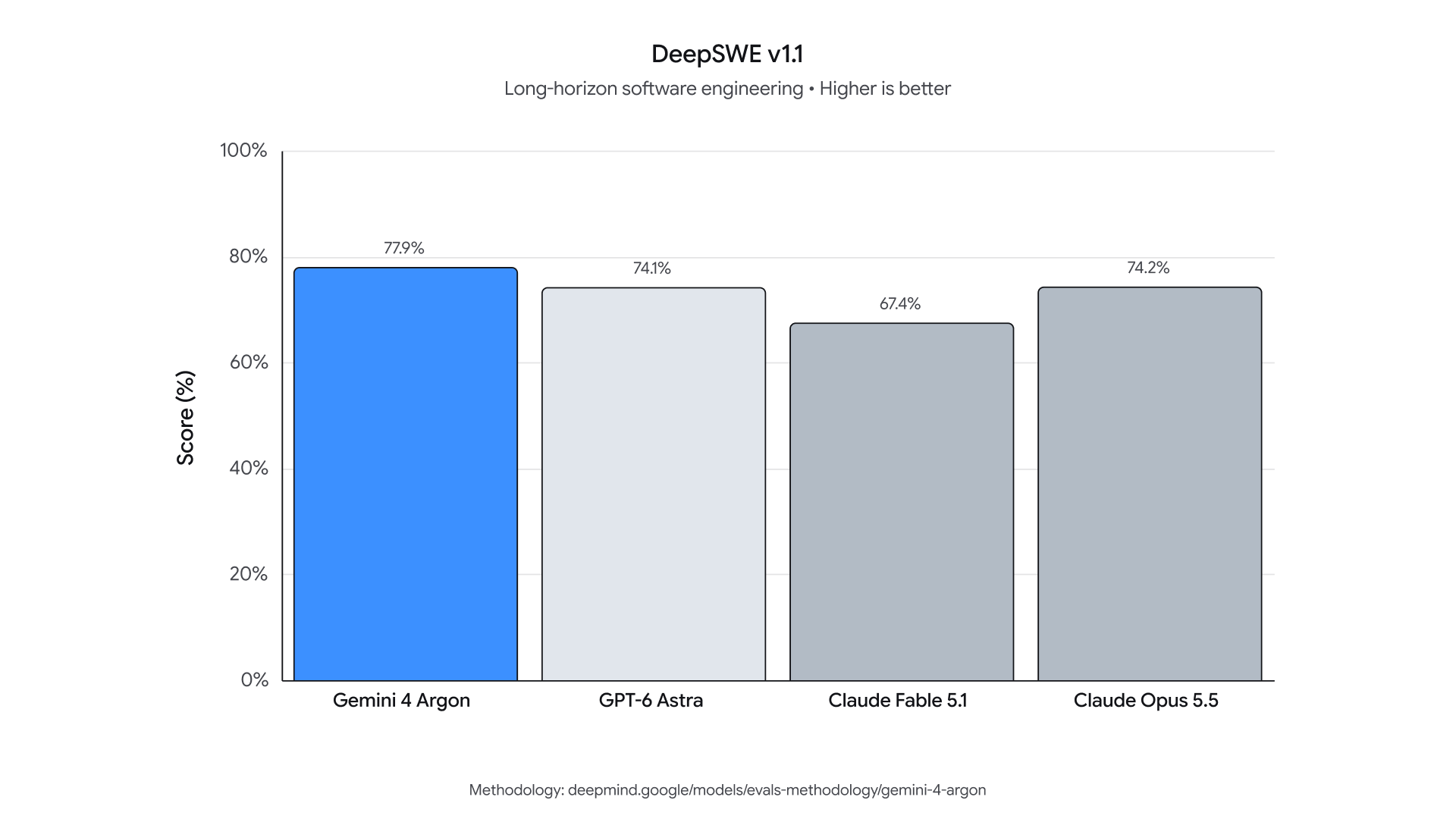
Google 工程师一直在日常任务中使用 Argon,从日常调试到大规模代码库迁移和算法设计。它在 DeepSWE v1.1(77.9%)上树立了新的最先进水平,该基准衡量模型在真实世界长周期软件工程任务中的表现。
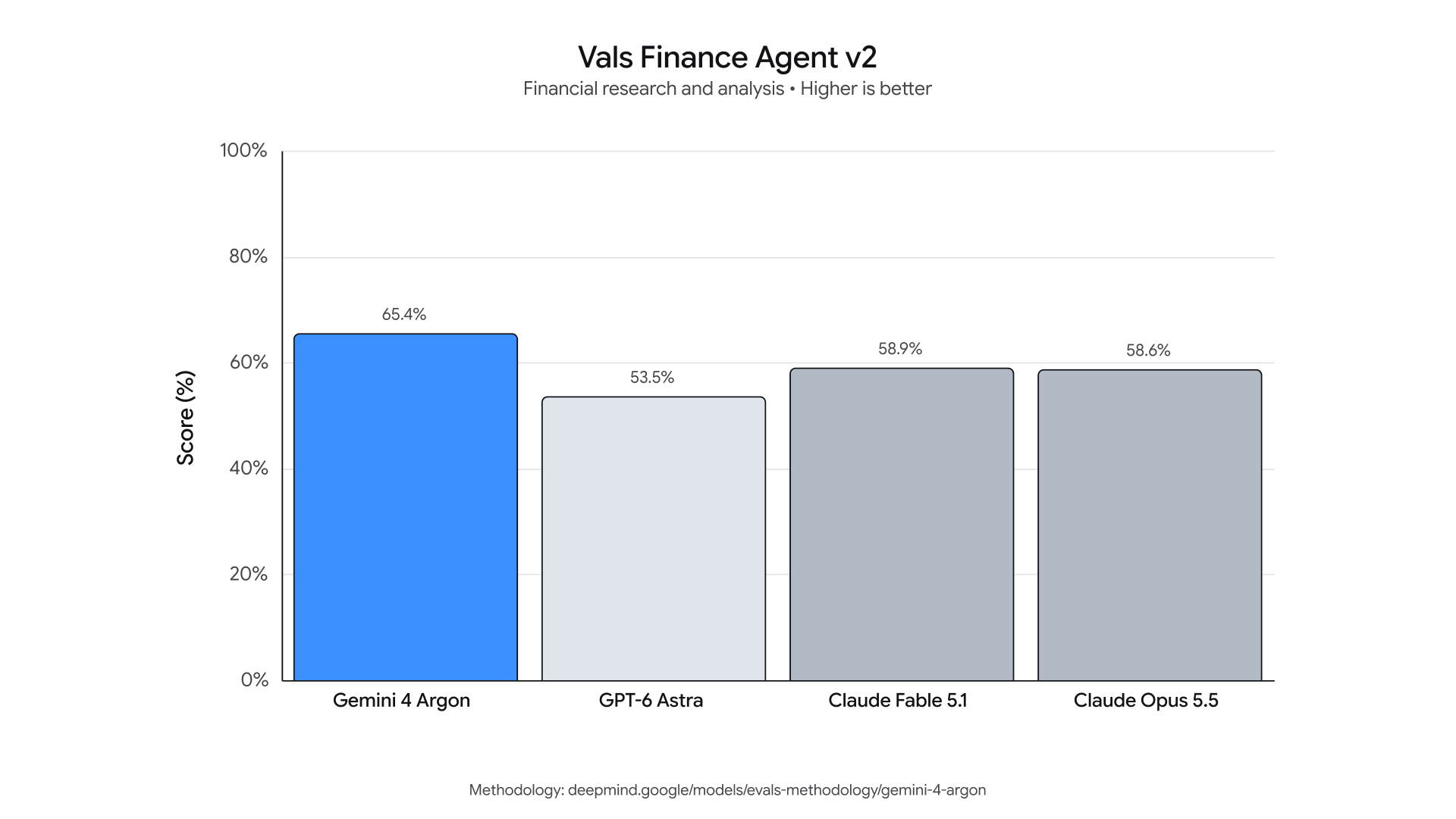
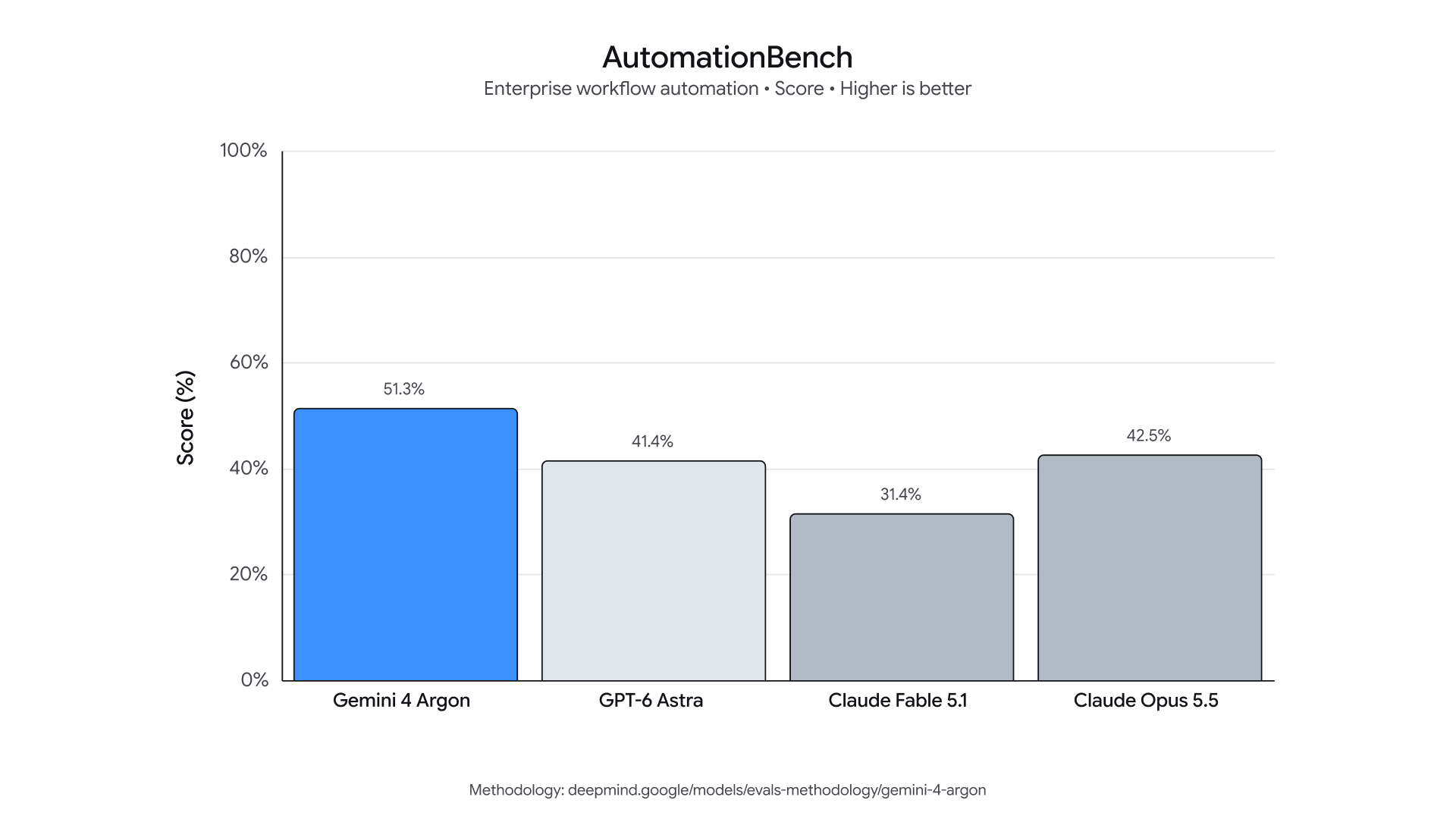
除编码外,Argon 还是 Vals Index 上的领先模型,该指数衡量金融、编码、法律和税务工作的经济影响,每个部门按其对美国 GDP 的贡献加权。我们在其他领域特定评估中也看到了类似的领先表现,例如 Vals Finance Agent v2(多步骤金融研究)和 Harvey 的 Legal Agent Benchmark(法律研究和起草)。在 AutomationBench 上,这是 Zapier 衡量核心业务职能端到端执行的基准,Argon 以 51.3% 的得分排名第一。
当知识工作需要视觉理解时,Argon 也格外强大。它能够进行专业图表分析、从长视频中识别细节,并根据一系列文档采取行动。例如,在衡量长视频理解的 LVBench 上,Argon 以 91.7% 的得分达到最先进水平。


引领防御性网络安全
为了更好地装备网络防御者以应对新时代的网络攻击,我们训练了 Gemini 4 Argon,使其在网络安全防御方面具备高度能力。Argon 能够自主发现、验证并修补关键软件漏洞。对于受信任的防御者以及我们谷歌内部团队,我们将发布不带网络防护栏的 Argon,以便他们能够充分利用其前沿级别的网络安全防御能力。
Wiz 已经通过其 Scan for Good 计划将 Argon 用于网络安全防御——该计划致力于通过发现并修复高风险暴露,免费保护关键公共基础设施。在其影响力的早期演示中,该模型发现了一个关键漏洞,暴露了全球医院所使用的医疗软件中的敏感个人信息,识别出了此前前沿模型遗漏的严重风险。
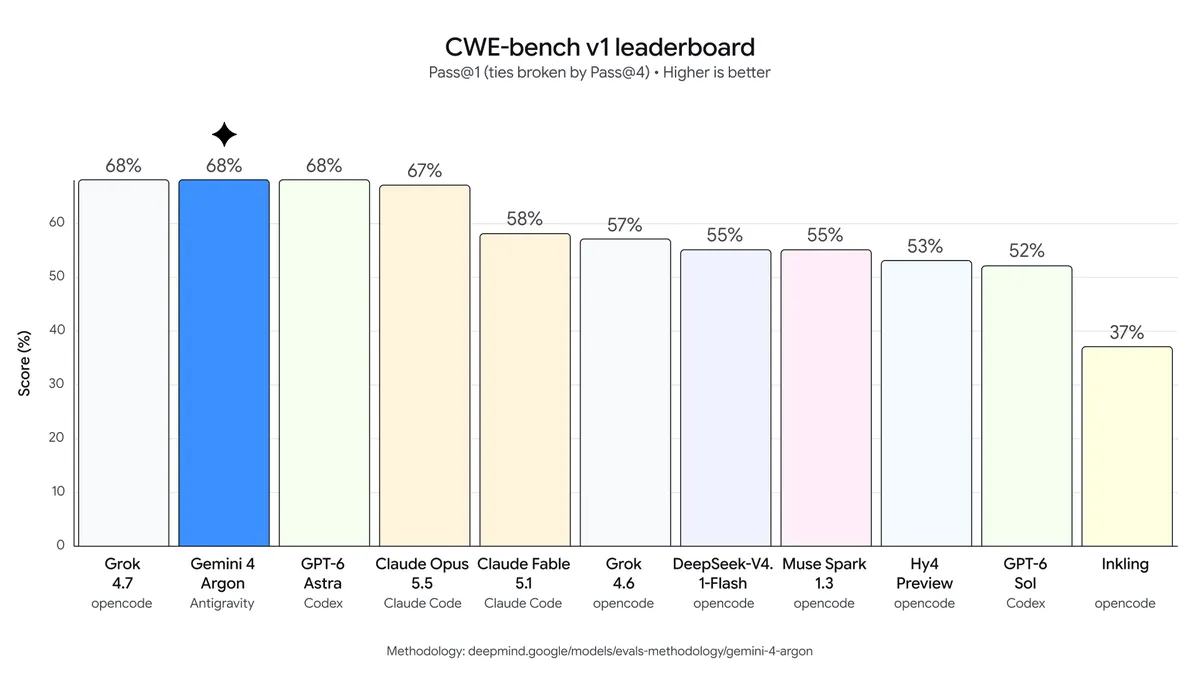
在评估模型修复安全漏洞能力的 CWE-bench v1 上,Argon 以 68% 的最高分并列第一,延续了 3.8 Flash Cyber 在 CWE-bench v0 上的前沿表现。
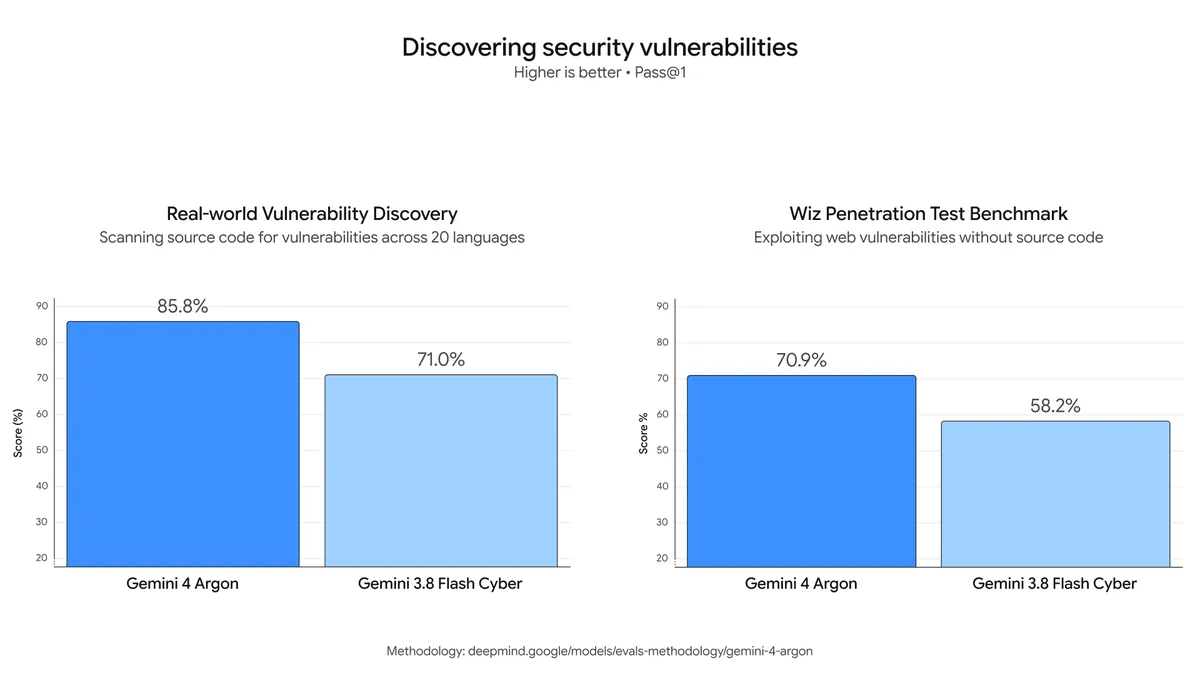
Gemini 4 Argon 在漏洞发现方面相较 3.8 Flash Cyber 展现出令人印象深刻的飞跃。例如:
- 在谷歌内部综合漏洞基准上,Argon 在涵盖 20 种编程语言的复杂代码库中发现了广泛的暴露。
- 在 Wiz 的内部黑盒渗透测试基准上,该基准测试模型在没有源代码的情况下分析实时网络系统的能力,Argon 在发现攻击面、识别漏洞并生成概念验证证据以验证漏洞方面优于 3.8 Flash Cyber。
在广泛可用之前加强前沿保障措施
在广泛推出 Gemini 4 Argon 之前,我们将继续在四个主要领域加强关键前沿保障措施:
防御滥用: 为防止恶意行为者利用 Argon 进行网络或化学、生物、放射和核(CBRN)攻击,该模型被设计为拒绝有害请求,同时根据我们的前沿安全框架,保留合法的两用科学研究。我们正在为此次发布加强保障措施的稳健性,包括改进我们监控模型内部激活以发现滥用的技术。这些保障措施经过了内部和外部红队的稳健性测试,使用了手动和自动化攻击方法的组合。
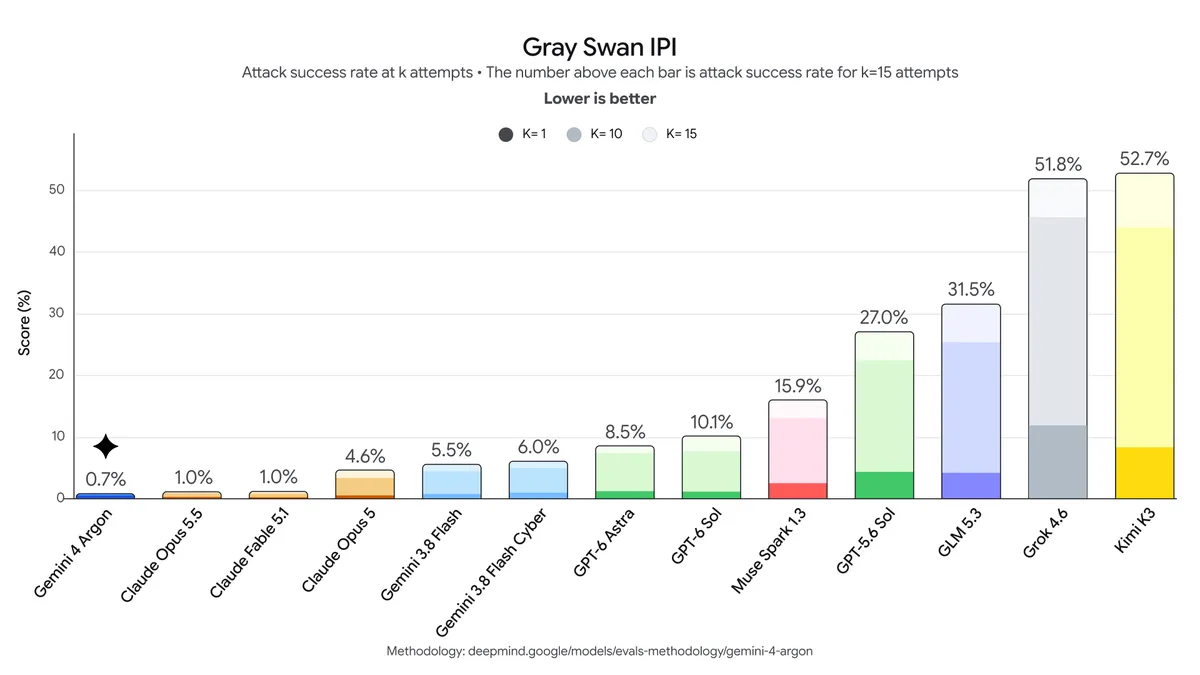
防御提示注入攻击: Argon 也是我们迄今为止对间接提示注入最具韧性的模型,间接提示注入是指利用恶意指令或上下文劫持模型行为。这些是复杂的攻击,需要持续警惕和多层防御。通过自动化红队测试和对抗训练,Gemini 4 Argon 在 Gray Swan 的间接提示注入(IPI)基准上处于提示注入稳健性领先地位。
监控失准: 为了防止 Argon 越界,以超出用户意图的方式尝试完成任务,我们部署了失准缓解措施,监控 Argon 的思维链和行动,并在必要时停止执行。
我们使用类似系统监控我们的训练运行,并向专门的事件响应团队发送警报,同时采取谨慎预防措施,避免将发现反馈到训练中,以免有塑造 Argon 推理以规避我们监控的风险。我们强烈鼓励业界其他各方在能力增强的关键时刻保持推理透明度,同时应对对齐风险,以便模型思维在识别和诊断失准方面仍然有帮助。
加固系统: 随着前沿模型能力日益增强,安全测试它们需要能够跟上系统本身的安全环境。根据我们的智能体控制路线图,我们正在通过在高风险训练或评估开始前隔离和密封沙盒环境来加固它们。我们致力于与合作伙伴分享这些智能体安全最佳实践,以提高整个生态系统的安全性。
即将推出
我们构建 Gemini 4 Argon 时,使其在编码、知识工作、网络安全防御和创意写作方面具备前沿级能力,从而成为开发者、专业人士和企业在解决最困难问题时的伙伴。我们感谢首批网络防御者和受信任测试者,他们的真实世界评估和反馈将帮助我们在向开发者、企业和消费者发布之前加强我们的系统,首先从付费 API 客户和 Google AI Ultra 订阅者开始。
Sep 30, 2026
|
Gemini 4 Argon delivers frontier performance in complex workflows across real-world software engineering, enterprise knowledge work like legal and finance, and cybersecurity defense.
Listen to article
[[duration]] minutes
This content is generated by Google AI. Generative AI is experimental
In this article
- Introducing Gemini 4 Argon
- Changing how we work and build at Google
- Working harder on your most complex problems
- Enabling coding and enterprise workflows across domains
- Leading in defensive cybersecurity
- Strengthening frontier safeguards before broad availability
- Rolling out soon
Today, we’re announcing our new frontier model, Gemini 4 Argon, which is rolling out to a set of trusted cyber defenders through our Fairwind Program. Built to sustain deep reasoning across complex, long-horizon workflows, Argon is fundamentally changing the way we work and build at Google. It delivers frontier performance in complex workflows across real-world software engineering, enterprise knowledge work like legal and finance, and cybersecurity defense.
Safely releasing frontier capabilities at this level requires a phased approach. We are actively engaged in the U.S. government’s voluntary process for pre-release model access while we gradually expand access. We’ll continue to gather feedback from early testers as we iterate on guardrails before making Argon available to developers, enterprises, and consumers as soon as possible.
Argon will launch at an introductory price 1 of $2 per million input tokens and $10 per million output tokens, with cached input tokens priced at 95% off input token price.
Changing how we work and build at Google
Gemini 4 Argon is already powering our internal workflows, with thousands of Googlers highlighting the model’s strengths in specialized coding tasks, conducting deeper research, and writing quality. It’s helping teams build faster and push the boundaries of engineering productivity and accelerating breakthroughs:
Quantum algorithmic optimization: Argon is helping our quantum computing researchers optimize the spacetime resources (qubits × gates) of subroutines that bottleneck important applications. In one example, it beat the published baseline by 40% in a matter of minutes.
Memory efficiency: A team of Argon agents analyzed fleet-wide profiling telemetry to autonomously identify and apply memory optimizations across Google’s data centers, freeing up over 300 TiB of memory once rolled out, with an estimated 500 TiB to 1 PiB in total savings.
Large Scale Codebase Migrations and Optimizations: Argon agents are working on migrating C/C++ codebases to Rust across Google — scaling from tens of thousands of lines in core libraries like re2, libgav1 up to 800K+ lines for the Fuchsia Zircon kernel. Given the criticality of many of these systems, such large-scale rewrites are undergoing rigorous automated and manual auditing, emulation testing, and review before rolling out to production. For libgav1, Google's open source software for decoding video, Argon agents took an existing Rust port and replaced 32K lines of SIMD code by running many rounds of profile-guided experiments, studying the compiler's output, producing safe Rust so the compiler would vectorize it automatically. The end result is a memory-safe video decoder that runs 2.7x faster than the Rust port, with identical video output, bringing it closer to the optimized C++.
Working harder on your most complex problems
To support Gemini 4 Argon’s capabilities across longer, more complex use cases, we are significantly expanding the model’s output token limit to an industry-leading 1M tokens, up from the previous 64K tokens. When the model has the headroom to think deeply and generate hundreds of thousands of tokens in a single trajectory, it adds a new level of depth in reasoning to solve tough problems in one go.
Enabling coding and enterprise workflows across domains
Gemini 4 Argon’s capabilities across coding, reasoning, and multimodality and its ability to sustain long, multi-step tasks enable it to excel across a range of enterprise workflows.
Google engineers have been using Argon for their daily tasks, from everyday debugging to large-scale codebase migrations and algorithm designs. It sets a new state of the art on DeepSWE v1.1 (77.9%), which measures a model’s performance in real-world long-horizon software engineering tasks.
Beyond coding, Argon is the leading model on the Vals Index, which measures economic impact across finance, coding, legal, and tax work, with every sector weighted by its contribution to U.S. GDP. We see similarly leading performance across other domain specific evaluations, like Vals Finance Agent v2 (multi-step financial research) and Harvey’s Legal Agent Benchmark (legal research and drafting). On AutomationBench, Zapier’s benchmark measuring end-to-end execution across core business functions, Argon ranks #1 with a score of 51.3%.
Argon is also uniquely strong when knowledge work requires visual understanding. It’s able to drive professional chart analysis, identify details from long videos, and take action based on a series of documents. For example, on LVBench, which measures long video understanding, Argon is state of the art with a score of 91.7%.
Leading in defensive cybersecurity
To better equip cyber defenders for the new era of cyberattacks, we trained Gemini 4 Argon to be highly capable at cybersecurity defense. Argon can autonomously find, validate, and patch critical software vulnerabilities. For trusted defenders and our own internal teams at Google, we’ll be releasing Argon without cyber guardrails so they can leverage its full frontier-level cybersecurity defense capabilities.
Wiz is already using Argon for cybersecurity defense through its Scan for Good initiative – a program dedicated to protecting critical public infrastructure for free by finding and remediating high-risk exposures. In an early demonstration of its impact, the model uncovered a critical vulnerability exposing sensitive personal information across healthcare software used by hospitals worldwide, identifying a severe risk that previous frontier models had missed.
On CWE-bench v1, which evaluates the model’s ability to remediate security vulnerabilities, Argon ties for first place with a top score of 68%, building on 3.8 Flash Cyber’s frontier performance on CWE-bench v0.
Gemini 4 Argon demonstrates impressive leaps in vulnerability discovery over 3.8 Flash Cyber. For example:
- On Google’s internal comprehensive vulnerability benchmark, Argon uncovered a wide range of exposures across complex codebases spanning 20 programming languages.
- On Wiz’s internal black-box penetration testing benchmark, which tests a model’s ability to analyze live web systems without source code, Argon outperforms 3.8 Flash Cyber in discovering the attack surface, identifying vulnerabilities, and producing proof-of-concept evidence to validate them.
Strengthening frontier safeguards before broad availability
Before rolling out Gemini 4 Argon broadly, we’re continuing to strengthen critical frontier safeguards across four main areas:
Defending against misuse: To prevent bad actors from using Argon for cyber or chemical, biological, radiological, and nuclear (CBRN) attacks, the model is designed to refuse harmful requests while preserving legitimate, dual-use scientific research, as per our Frontier Safety Framework. We are strengthening the robustness of our safeguards for this launch, including improving our techniques to monitor the model’s internal activations to spot misuse. These safeguards underwent robustness testing by internal and external red teams using a combination of manual and automated attack methods.
Defending against prompt injection attacks: Argon is also our most resilient model yet against indirect prompt injections, where malicious instructions or context are used to hijack a model’s behavior. These are complex attacks that require constant vigilance and multiple layers of defense. Through automated red teaming and adversarial training, Gemini 4 Argon is leading in prompt injection robustness on the Gray Swan’s Indirect Prompt Injection (IPI) benchmark.
Monitoring for misalignment: In order to prevent Argon from stepping out of bounds to try to accomplish a task in a way that goes beyond the user’s intentions, we are deploying misalignment mitigations that monitor Argon’s chain-of-thought and actions and stop execution when necessary.
We used a similar system to monitor our training runs and send alerts to a dedicated incident response team, taking careful precautions against feeding the findings back into training so as to not risk shaping Argon’s reasoning to evade our monitoring. We strongly encourage the rest of the industry to preserve reasoning transparency in these pivotal moments of increased capabilities while navigating alignment risks, so that model thoughts remain helpful in identifying and diagnosing misalignment.
Hardening systems: As frontier models grow increasingly capable, safely testing them requires secure environments that can keep up with the systems themselves. In line with our agent control roadmap, we are hardening our sandboxed environments by isolating and sealing them before high-risk training or evaluations begin. We’re committed to sharing these agent security best practices with our partners to improve security across the ecosystem.
Rolling out soon
We built Gemini 4 Argon with frontier-level capabilities on coding, knowledge work, cybersecurity defense, and creative writing to be a partner for developers, professionals, and enterprises while they tackle the most difficult problems. We’re grateful for the initial cohort of cyber defenders and trusted testers whose real-world evaluations and feedback will help us strengthen our systems before we release to developers, enterprises, and consumers, starting with paid API customers and Google AI Ultra subscribers.
本文内容采集自官方网站,排版和翻译可能与原页面存在差异。
阅读官方全文